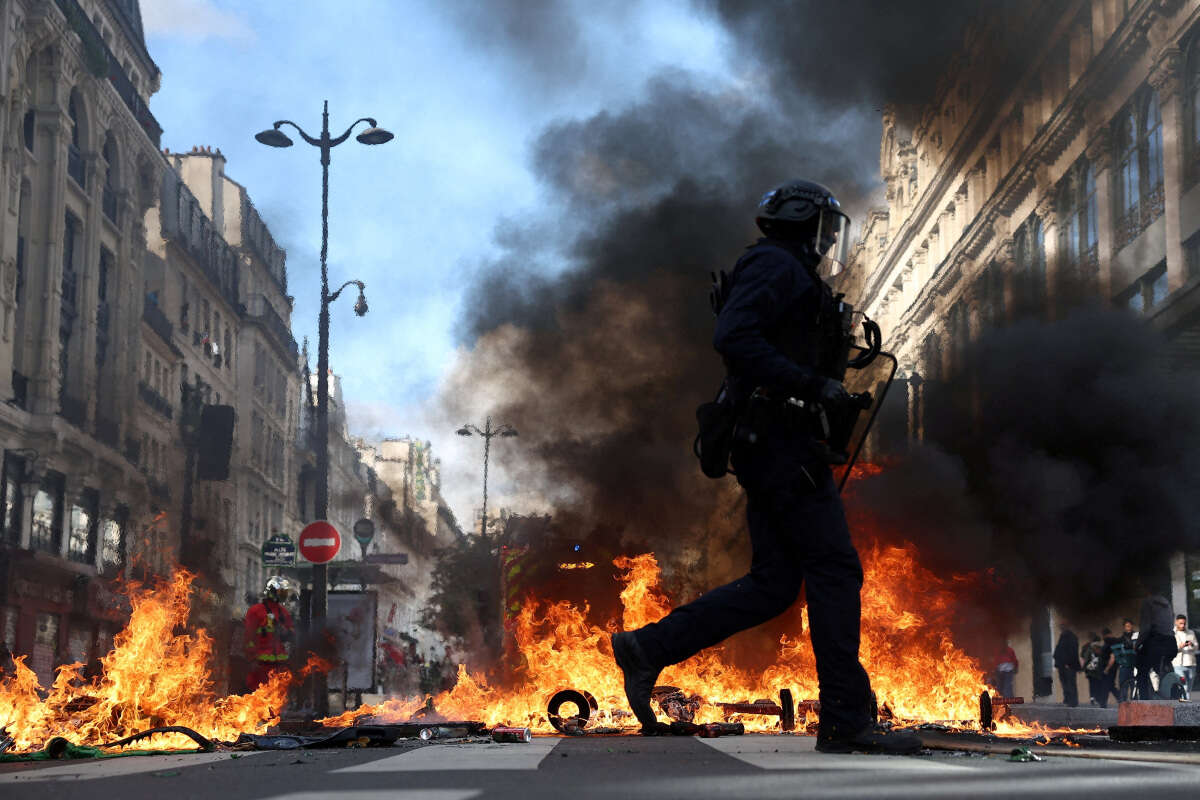
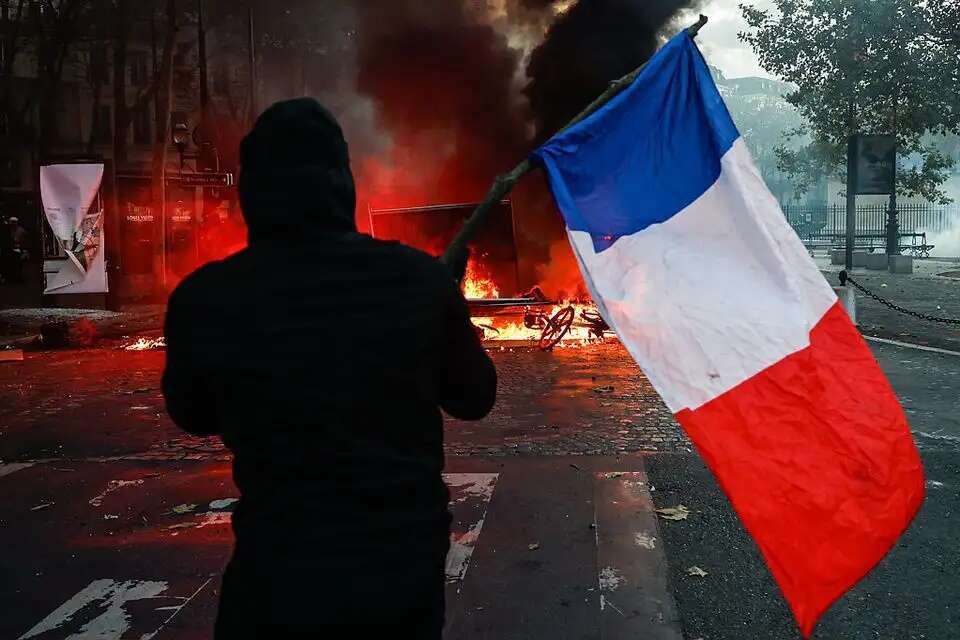
The flying of Palestinian flags and the cries of "intifada" in the streets of France are no longer just a social protest but evidence of a pattern of action that threatens the values of the entire Western world. The struggle that Israel wages against radical Islam is the first line of defense in this battle as well.
"Unacceptable and ridiculous" — so French President Emmanuel Macron characterized remarks made by foreign leaders, among them US President Donald Trump, on the link between immigration to France and the severe violence that erupted in its streets.
He railed against leaders "in certain regions or on the other side of the Atlantic" who, he said, are running political campaigns on France's back, and forcefully rejected the claims that his country has been flooded by masses of migrants and Islamists.
Macron's remarks came after Trump referred repeatedly to these riots as ammunition ahead of the US midterm elections. The American president urged voters to "just look at France" and added, "Paris is going to become a Muslim city very soon." He did not miss the opportunity to remind the French: We warned you.
On the other side, moments before taking off on a diplomatic tour of Taiwan and the Gulf states, Macron warned that anyone who tries to sow disorder at protests expected over the weekend will be arrested. It is unclear what went through his mind when he nevertheless decided to leave the management of the crisis on the ground in the hands of Interior Minister Laurent Nuñez, that same interior minister who only a week ago submitted his resignation (which was declined) because he had failed in handling the riots.
Not an internal French affair
The violent riots in France are no longer merely an internal affair of a European power. In the United States they have become a central issue in the domestic social and political confrontation, especially ahead of the elections in about two weeks. Representatives of the Democratic Party continue to argue that the riots stem from deep economic crises and from insufficient investment in social infrastructure. By contrast, representatives of the Republican Party, headed by Donald Trump, J. D. Vance and Senator Ted Cruz, are calling on the public to see these events as a warning sign against permissive immigration policy and the adoption of progressive conceptions.
As noted, calls for "intifada" and the flying of Palestinian flags are not confined to France or Europe. They have seeped extensively into campuses and public spaces in the United States. Hand in hand with this phenomenon, even if not solely through its influence, there has been a rise in manifestations of antisemitism and a shift in public attitudes. A poll conducted by the Gallup Institute this February found, for the first time since 2001, that the proportion of Americans expressing sympathy for the Palestinians is higher than the proportion of Americans who sympathize with Israel (41 percent versus 36 percent, respectively).
A sober American look at the riots in France should lead to the recognition that what is at issue is not a local protest over human rights or about investment in educational infrastructure, but a broader strategy that challenges sovereignty and law.
The mingling of civil protest with support for the Palestinians and with the political struggle against Israel indicates that the social demands are merely an opportunistic pretext. More than that, even the calls in favor of the Palestinians are not the true reason for the struggle. The enormous efforts Macron made to advance the idea of a Palestinian state will testify to this, and in the end they helped him against the protests like cupping glasses on a dead man.
The war of the demonstrators is a war of chaos against order. It is akin to the wars that Middle Eastern "forces of resistance" wage against Israel. These wars are meant to enable the forces of rage and fanaticism, arrayed against the organized and stable state of affluence of countries like France; to undermine the standing and values of the West.
The public in the US must see Israel as a vital strategic asset in the struggle for its values. Israel is not only a security and technological partner of great value to the US. Nor is it merely the central pillar of the pro-American architecture at the crossroads between Europe, Asia and Africa.
Above all, Israel is situated on the cultural fault line of our age, in one of the most volatile regions in the world, as an outpost of the very values of which the US boasts. Israel stands on the first front line of Western democracies against radical Islam. Standing at Israel's side ensures the preservation of the values that America is anxious about. On the other hand, marching down a path that weakens Israel will bring about the cracking of the defensive walls of the entire free world. America's defensive walls too.
My colleague Dr. Hanan Schwartz suggests that Israel extend a hand to Europe and place at its disposal the experience Israel has accumulated over decades of struggle. However, President Macron's attitude toward the rioters and their motives casts doubt on the ability of Israel to reach agreement with Europeans on the diagnosis, the prognosis, or the modes of response to the riots.
Nevertheless, one should not despair. More important is the need to drive home the relevant lessons to the United States. There too, it will not be easy to persuade those who think differently, but the effort is necessary even if it persuades only the already persuaded, so that they do not fall for the delusionary narrative that Macron and his colleagues are selling themselves.

Adding fuel to the fire
In an official statement published this week, the Hamas movement called for the activation of "Palestinian activism" abroad to force Israel to halt its operations in Gaza.
Hamas spokesman Hazem Qassem expressed disappointment that Palestinian activity today does not strongly enough reflect the broad Palestinian presence in countries of the world.
The remarks were published in Al Jazeera during Macron's visit to Qatar. Someone should bring this to the attention of President Macron, just in case he is still wondering who is fanning the flames in the streets of Paris.
Josh Greenbaum, a senior adviser to the US-led Board of Peace, said this week that the deradicalization process in the Gaza Strip will be led by the Palestinian National Committee for the Administration of the Strip. According to him, members of the committee are closely familiar with the existing education system, including that operated by UNRWA, since their children grew up within it. As part of the process, a Palestinian technocratic government will be responsible for vetting the suitability of teachers.
It is hard to know whether Greenbaum really means what he says or whether this is just lip service meant to keep the "Trump Plan" for Gaza alive. The chances of bringing about a radical change in the attachments and positions of the public in Gaza in the foreseeable future are slim in the case of a miracle, and nil without one.
Gaza is unlike other cases throughout history in which deradicalization programs have recorded successes. First, because Hamas ideology is interwoven with the religious identity of Hamas supporters, and second, because of the high proportion of Hamas supporters in Gaza. More than half the population in Gaza was born into a reality in which Hamas is the government.
The Gazan population has absorbed Hamas ideology in educational institutions controlled by it, consumed Hamas media, prayed in Hamas mosques, and been wrapped from head to toe in the propaganda of the terrorist organization. This public will continue to preserve this ideology.
A third reason is regional influences. Gaza will continue to be situated at the heart of a region in which there is a dominant presence of the ideologies of the Muslim Brotherhood, and in an open environment through which that same ideology will continue to propagate, thereby offsetting any counterefforts.
Placing this portfolio in the hands of a Palestinian committee that will also select teachers completes the circle of naivety surrounding the entire idea. Whoever wishes to wallow in illusions, go ahead! But Israel must not pay prices or take any risks for such bad ideas.
One pays for threats
If the reports are correct that senior Hamas officials have conveyed to Israel through the UN coordinator explicit threats to attack it again in a manner similar to October 7, then one must wonder at the absence of an appropriate Israeli military response. Whoever conveyed such a threat, together with the entire chain of those involved on Hamas's side, should be dead men.
Israel must make clear that even the very threat of such attacks carries a cost.
The writer is head of the Jerusalem-based Misgav Institute for National Security & Zionist Strategy. He served as head of the Israel National Security Council, 2017-2021. (First published in Hebrew in Makor Rishon, October 23, 2026.)