Across the Middle East, regional leaders and analysts reacted Wednesday morning to the preliminary results of the Israeli elections. The prevailing consensus suggests that forming the next governing coalition will prove exceptionally challenging. While certain commentators view the outcome as a notable achievement for Prime Minister Benjamin Netanyahu, others argue it highlights his diminishing political power. At the same time, regional observers maintain that a transition in leadership will not necessarily produce a fundamental shift in Israeli foreign policy.
"The elections failed to give Benjamin Netanyahu or Gadi Eisenkot the 61-seat majority required to form a government," noted Emirati political analyst Muhammad Faisal al-Dosari. "Likud remains in the lead, and the Arab parties command a bloc of seats that could theoretically tip the scale for the opposition – though its unwillingness to partner with them complicates the calculus. Caught between a unity government, a minority government, or fresh elections, Prime Minister Benjamin Netanyahu may remain in power temporarily despite the breakdown of his coalition."
By contrast, UAE-based Lebanese commentator Nadim Koteich offered a radically different reading of the outcome. "Prime Minister Benjamin Netanyahu secured one of the greatest victories of his political career, even without reaching 61 seats," he argued Wednesday morning. "This election was a referendum on his personal future, and he emerged as the head of the largest party in Israel." Koteich went further to suggest immediate security ramifications, asserting, "The primary takeaway: A strike in Iran has become a matter of days."
In Cairo, officials made it clear that the distinction between the top contenders holds little practical meaning for the region. Egyptian Member of Parliament Mustafa Bakri stated overnight, "Whether Gadi Eisenkot or Benjamin Netanyahu manages to form the next Israeli government, they represent two sides of the same coin." Bakri pointed out that Gadi Eisenkot served as IDF chief of staff from 2015 to 2019 and linked him to formulating the Dahiya doctrine – a strategy centered on targeting infrastructure in areas utilized for attacks against Israel.
"Arab celebration over Benjamin Netanyahu's failure to form a government does not mean his successor – who is of Moroccan heritage – will act any differently," Bakri added, referring to the possibility of Gadi Eisenkot assembling a governing coalition.
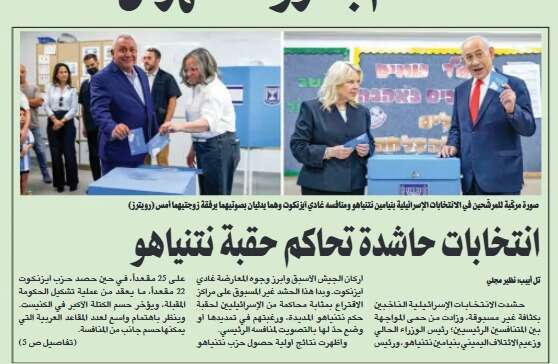
Saudi news outlets also provided extensive coverage of the results and the high voter participation. "Massive elections put the Netanyahu era on trial," declared a front-page headline in the newspaper Asharq Al-Awsat. The report highlighted that the vote drove unprecedented citizen turnout, escalating the political showdown between Netanyahu and his primary rival, Eisenkot.
The Saudi daily reported that high voter turnout underscored the public's drive to decide whether to extend Netanyahu's leadership or end it by backing his opponents.
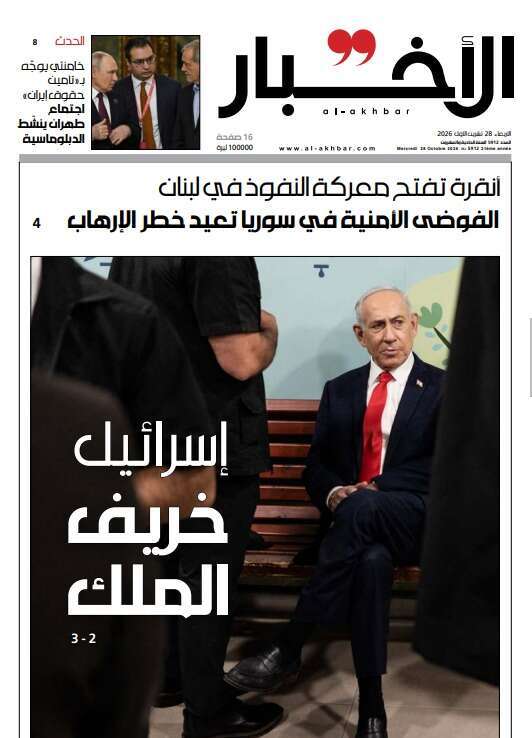
In Lebanon, news organizations displayed stark contrast in their editorial framing. "Israel: The King's Doldrums," ran the cover headline of the newspaper Al-Akhbar, an outlet aligned with Hezbollah. The paper argued that the election demonstrates Netanyahu's political decline, though it noted the result does not definitively end his career – largely due to fractures among his rivals and their failure to present a cohesive alternative.
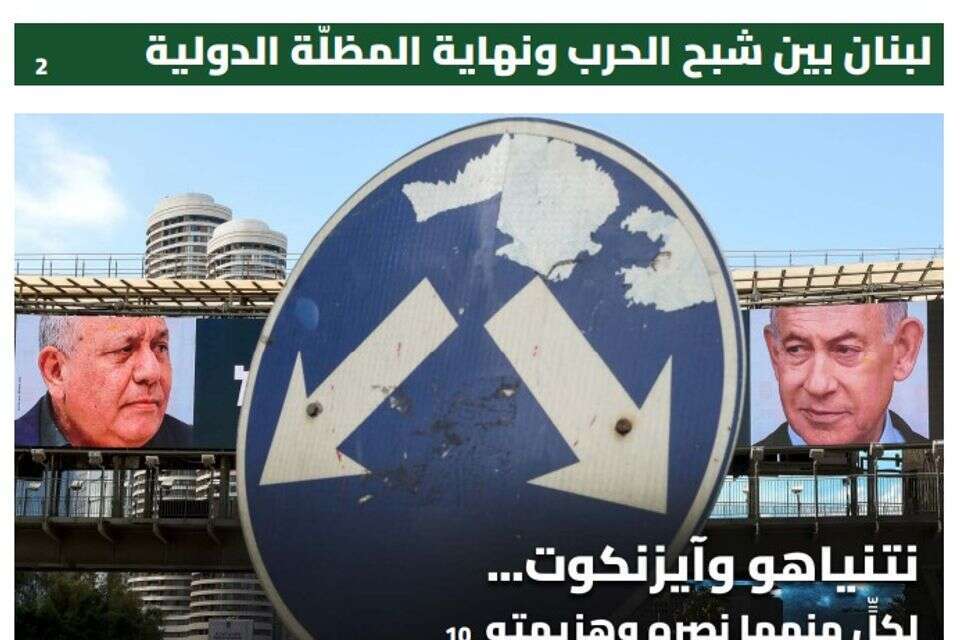
The daily further contended that despite internal political friction within Israel, defense policies toward the Palestinians and neighboring countries will remain firm regardless of who holds power. On the other hand, the Lebanese newspaper Nidaa al-Watan, which aligns with anti-Hezbollah factions, framed the outcome more neutrally: "Netanyahu and Eisenkot: Each with his own victory and defeat."
Overall, reactions across the Arab world reflect deep uncertainty over the election results and the path toward a stable Israeli government. While some analysts see a window for Prime Minister Benjamin Netanyahu to maintain his grip on power, others view the numbers as clear evidence of his waning influence. Nevertheless, broad consensus remains on one key point: A change in Israeli leadership is unlikely to alter the country's strategic posture in the region.