Learning Hebrew is no easy feat. Between confusing similar-sounding words, mixing up genders and accidentally saying something entirely different from what you intended, even the most innocent conversations can take an unexpected turn.
For many new olim, getting the hang of the language means occasionally making embarrassing mistakes – and sometimes saying something with a completely different, and often hilarious, meaning. From accidentally declaring their love for wet wipes to telling patients to look after their corpses, here are 10 memorable Hebrew mishaps shared by non-Israelis navigating life in Israel.
1. A relationship misunderstanding at Ben-Gurion Airport
David was standing in line for airport security at Ben-Gurion Airport, heading home to the United States after his first visit to Israel. A young woman wearing a head covering, (indicating that she was married), was standing alone in line behind him. When a security agent asked David, " אתם ביחד ?" (Are you together?), referring to him and the woman, David confidently replied, " כן " (Yes).
The woman, whom he had never met, looked horrified. David then repeated, " אני ביחד ."
Realizing there was some confusion, he tried again: ", כן, אני יחיד " (Yes, I am single).
Either the woman explained in perfect Hebrew that she had no idea who he was, or those around him finally understood what he meant – or perhaps both. Either way, it was certainly a memorable interaction!
2. Falling in love with wet wipes
When Ari first made aliyah from Argentina, he went to a restaurant with his Israeli cousins and was given a sealed packet containing a wet wipe at the end of the meal, as is common practice in Israel. Wanting to ask for more wipes, he asked his cousins how to say "wet wipes" in Hebrew.
Armed with his new vocabulary, Ari approached the waitress and simply announced, אני אוהב מגבונים" " (I love wet wipes).
The waitress burst out laughing but eventually handed him more wipes.
Confused, Ari returned to his cousins and asked what he had said that was so funny. It turned out that he had translated directly from Spanish. In Spanish, the verb querer can mean both "to want" and "to love." While Ari intended to ask for more wet wipes, he had effectively declared his love for wet wipes to the amused waitress.
3. Excited to be divorced
Justine Moyles, an olah from Johannesburg, South Africa, was 23 years old and was spending six months on Kibbutz Tzora, where she was doing ulpan and working in the self-service kitchen.
One morning, while talking to the person in charge, she wanted to express how excited she was to be at work at 5 a.m.
Instead of saying מתרגשת (excited), however, she said מתגרשת (getting divorced).
The man was understandably confused, but "he laughed!" Justine recalled.
4. A little too much sunbathing
Hannah was chatting with her coworkers one day about how she'd like to sunbathe, and used the Hebrew expression להתחרדן בשמש – to bask in the sun.
Her colleagues burst out laughing while she was talking. Not understanding what was so amusing, Hannah asked them to explain. Apparently, she had said להתחרבן בשמש – which means to defecate in the sun.
A slight change in pronunciation can make quite a difference!
5. A dog with questionable politics
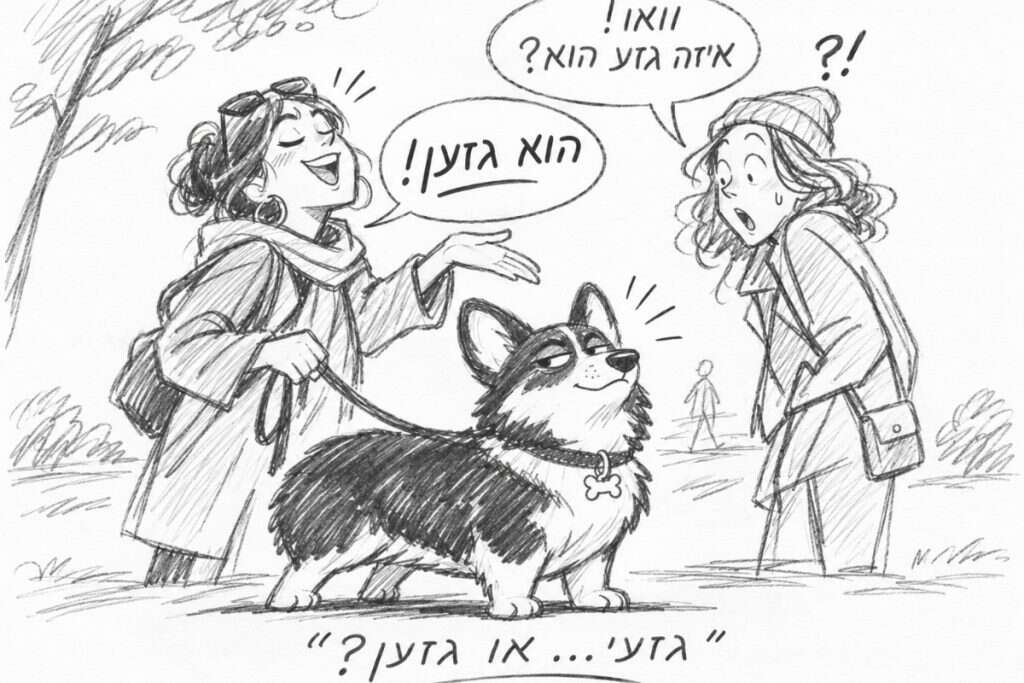
Maria Oleneva owns a black Corgi, although many people aren't sure what breed he is and often ask her.
Someone once asked whether her dog was a mutt or a mix. Maria wanted to explain that he was purebred ( גזעי ), but instead accidentally called him גזען – a racist.
Rather than describing her dog's pedigree, Maria had inadvertently called his character into question.
6. A very unusual baby milestone
Talia, a nurse at Tipat Chalav, was talking to a mother about her baby's motor skills and wanted to ask whether the baby could lift his chest (בית חזה).
Instead, she accidentally asked whether he could lift his chicken breast (חזה עוף).
The small vocabulary mix-up turned a routine developmental check into a rather unusual conversation about poultry.
7. 'I cooked the kids'
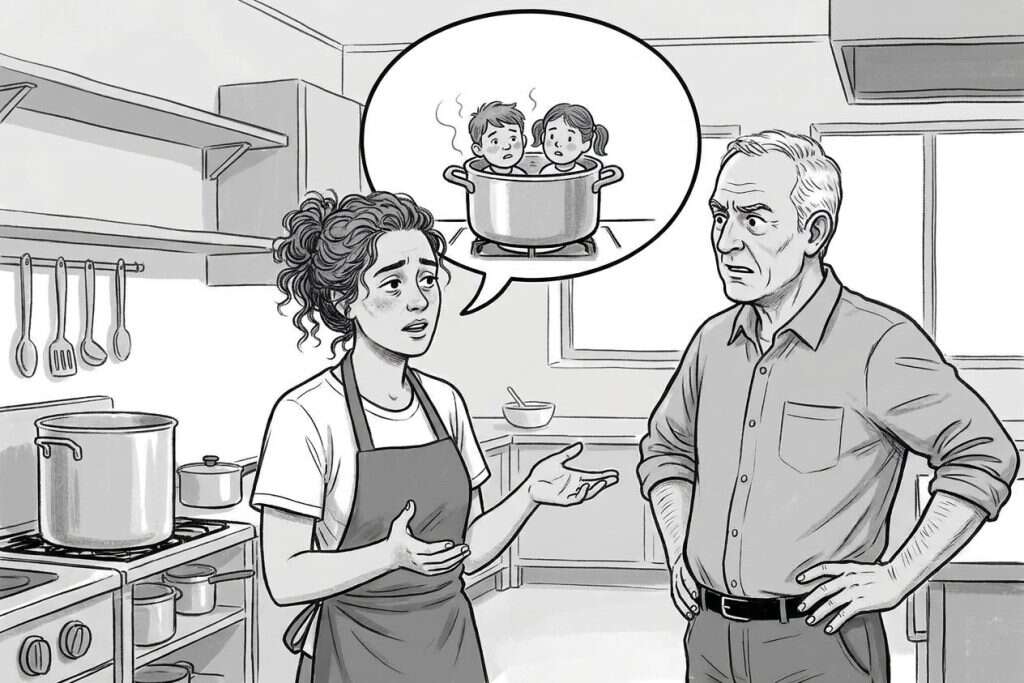
Reeva Brown is originally from South Africa but also lived in New Zealand and Australia for several years before making aliyah. She recalled a particularly memorable moment from ulpan. A friend of hers once arrived late to class and tried to apologize by explaining that she had been busy getting her children ready. But instead of saying, " סליחה, הלבשתי את הילדים " (Sorry, I had to dress the children), she said, "סליחה, בישלתי את הילדים"
In other words: "Sorry, I cooked the kids."
A rather different explanation for being late!
8. The importance of looking after your corpse
Edda Eisenstadt Weissberg shared that her husband Ed Nachum, a doctor, once told a patient that it was very important to take care of his body. But instead of saying לשמור על הגוף (look
after the body), he said לשמור על הגופה (look after the corpse).
He couldn't understand why the patient looked at him with a horrified expression.
On another occasion, he told a pregnant woman that it was important לעשן הרבה (to smoke a lot) during pregnancy, when he had meant to say לישון הרבה (to sleep a lot).
Two very different pieces of medical advice – and presumably not what either patient was expecting to hear!
9. A rather embarrassing fruit platter
During her national service, Lisa wanted to offer her entire department a platter of dried fruit. Unfortunately, she called it פלטת פירות מתביישות (an embarrassed fruit platter)
instead of פלטת פירות יבשים (a dried fruit platter).
Her colleagues were apparently so amused that they stopped hiring lone benot sherut (female national service volunteers) for a while!
10. A very unfortunate hospital direction
Sarah Idan from Wales works in the eye department at Hadassah Ein Kerem. She shared that she once tried to reassure a patient who had gotten lost in the hospital by telling him that it was easy to get lost there.
"Don't worry," she said, " קל ללכת לאיבוד פה " – it's easy to get lost here.
What she actually said, however, was: " קל להתאבד פה " – it's easy to commit suicide
here.
A small linguistic slip with a very different, and considerably more alarming, meaning.