
The Eagle's Nest, the mountaintop guesthouse where Adolf Hitler entertained senior Nazi officials and other guests, has become the focus of a heated debate in Germany after being largely destroyed by fire last month. Known in German as the Kehlsteinhaus, the building stands on a mountain ridge 1,834 meters (6,017 feet) above sea level, overlooking the Bavarian town of Berchtesgaden. Built by the Nazis in 1938, it was later designated a historic landmark.
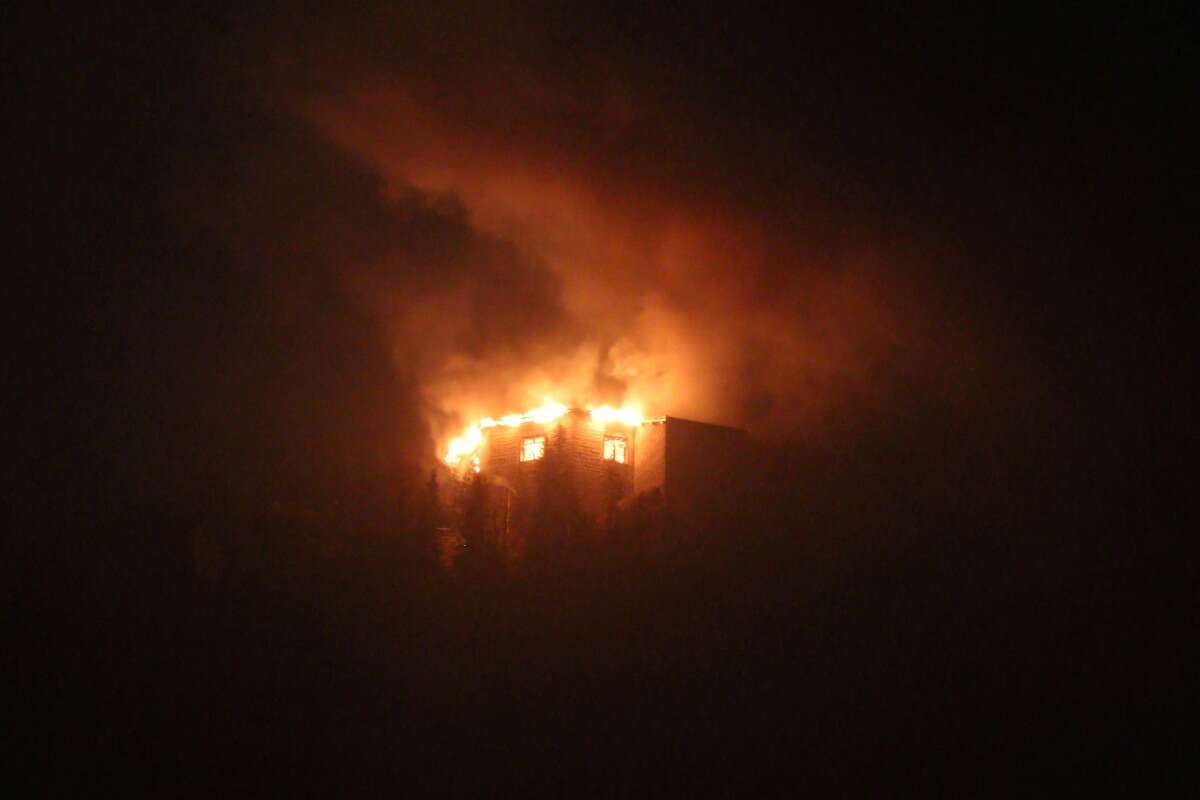
A fire broke out at the site on the evening of Oct. 23, leaving the building "largely destroyed," according to police. A 33-year-old man with a diagnosed mental illness was arrested on suspicion of arson and placed in a secure psychiatric hospital. Authorities have not disclosed a motive.
Unlike Hitler's nearby mountain residence, the Berghof, which was bombed during World War II and demolished in 1952, the Eagle's Nest survived the war. In recent years, it housed a restaurant and attracted tens of thousands of tourists each season, many of whom reached it via the original elevator built into the mountainside. A nearby documentation center dedicated to the crimes of the Nazi regime, which opened in the 1990s, was unaffected by the fire.
Some experts now believe the site should be allowed to disappear. "It was set on fire and destroyed. In my view, the rubble should be cleared away and the mountain returned to its natural state," said Sir Richard Evans, a Cambridge University historian specializing in Nazi Germany.
Evans pointed to other former Nazi sites that had been dismantled or concealed, including the Berlin bunker where Hitler died by suicide, which was filled in with concrete, with a playground built above it.
Bavarian authorities take a different view. State Interior Minister Joachim Herrmann and Arts Minister Markus Blume both support rebuilding the site. "We can hardly leave a ruin standing there," Herrmann said.
Sven Keller, director of the Obersalzberg Documentation Center, warned that an abandoned ruin could become a pilgrimage site for neo-Nazis, who might be able to reach it without interference. He noted that the demolition of the Berghof had failed to erase the site from public consciousness.
Nevertheless, Keller also opposes an exact reconstruction of the building. Blume has insisted that any restoration must not cost taxpayers money.
Professor Isabel Heinemann, a historian at Ludwig Maximilian University of Munich, also rejects a complete reconstruction, arguing that it would amount to reinstating architecture explicitly designed to serve Nazi ideology. Instead, she suggests documenting the building's post-fire condition and surviving historic features, while reconstructing certain sections in a modern style that would make the different layers of its history visible.
The debate comes against a backdrop of growing far-right influence in Germany and Austria. Recently, local council members from the far-right Alternative for Germany (AfD) and the center-right Christian Democratic Union (CDU) voted to ban the installation of new Stolpersteine, or "stumbling stones," small brass memorial plaques embedded in sidewalks to commemorate victims of Nazi persecution, in the Saxon town of Heidenau.
In Austria, a police station opened this summer in the house where Hitler was born in Braunau am Inn, following years of controversy over what should become of the building.