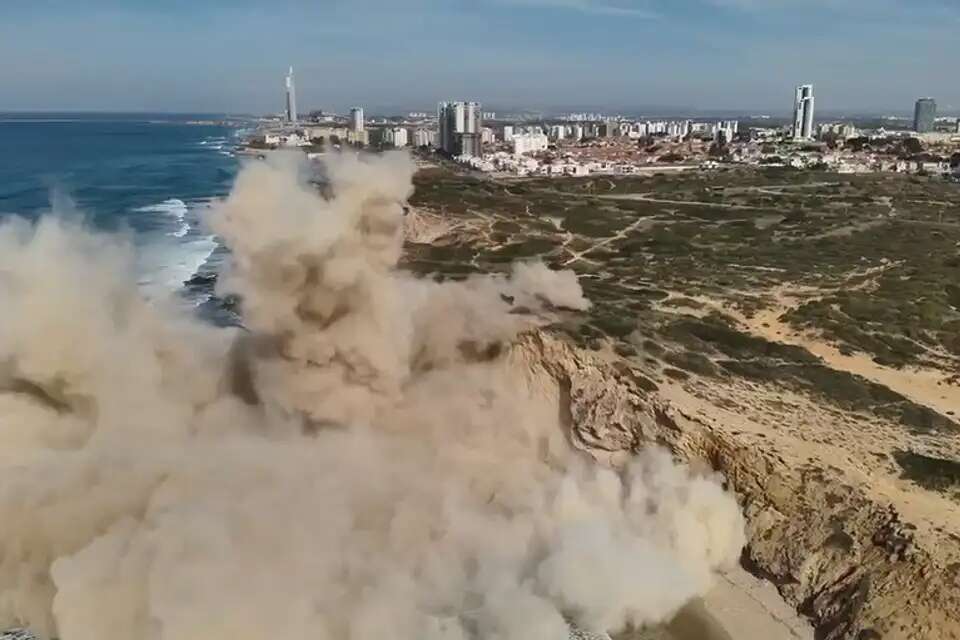
The Israel Nature and Parks Authority carried out a controlled demolition of a cliff near Tel Gador Beach, south of Hadera, on Thursday, completing the first phase of an engineering operation to remove a dangerous sandstone rock formation. The next phase will assess how to stabilize the remaining cliff. The authority warned that numerous stretches of coastline between Herzliya and Hadera face similar risks, urging visitors to stay away from cliff edges and bases.
The authority completed the first phase of the engineering operation Thursday morning at the Gador Beach Nature Reserve in the Sharon region. The upper section of the cliff was deliberately brought down in a controlled explosion amid serious concerns that a sudden collapse could pose an immediate threat to the lives of visitors on the beach below.
Video: A controlled demolition was carried out at Tel Gador Beach near Hadera over fears of a sudden cliff collapse /// Video: Israel Nature and Parks Authority
The operation was conducted under the close supervision of the Israel Antiquities Authority and in coordination with the Hadera Municipality. Officials will subsequently assess the need for stabilization work on the remaining cliff, and a new hiking trail will be made accessible atop Tel Gador.
Guy Levian, deputy director of the Israel Nature and Parks Authority's marine unit, said the area had been fenced off and warning signs installed during the operation, stressing that it remained closed to the public. "Further work is planned to stabilize the cliff," Levian added. "It is important to remember that similar dangers exist along many stretches of coastline between Herzliya and Hadera, and people should stay away from cliff edges and bases."
Although the Gador Beach Nature Reserve attracts many hikers and families, the authority explained that the sandstone cliffs overlooking the beach pose a significant hazard. Masses of rock and sand weighing hundreds of kilograms can break loose and collapse without warning. The risk is particularly high along narrow stretches of beach, where visitors have little room to move away quickly.
Last March, the authority installed additional warning signs along a roughly 300-meter (980-foot) stretch of the reserve between two coves known locally as "Chinese Bay" and "Bay 70." It also released a public awareness video on social media. Nevertheless, officials said many visitors continue to disregard the signs and spend time directly beneath the cliffs.
Cliff erosion is a well-known phenomenon along Israel's coastline, with collapses becoming more frequent in recent years, particularly in the Sharon region, Netanya and Tel Aviv. Contributing factors include waves battering the base of the cliffs, erosion, structural instability and surface runoff. As recently as February, a cliff collapsed at Sidna Ali Beach in Herzliya, with no injuries reported. The Israel Nature and Parks Authority reiterated its warning to stay away from cliff edges and bases, obey warning signs and use only designated trails.