Israel Hayom is a media organization founded on the belief that the Israeli public deserves better journalism—more balanced, more accurate, and more reliable. Journalism that speaks rather than shouts. Journalism that is trustworthy, objective, and matter-of-fact. A different kind of journalism, offered free of charge.
The first print edition was published on July 30, 2007, and in 2010 Israel Hayom became the Israeli newspaper with the highest weekday readership. The newspaper’s publisher is Dr. Miriam Adelson. Its Editor-in-Chief is Omar Lachmanovitch, and its founding editor is Amos Regev.
Israel Hayom’s Hebrew and English websites, as well as its Android and iOS applications, provide around-the-clock news coverage, exclusive content, breaking news and updates, analysis and commentary, video, podcasts, and live broadcasts.
The digital platforms of Israel Hayom include news and opinion channels covering culture and entertainment, lifestyle, technology, sports, business and consumer affairs, health, military affairs, food, Judaism, tourism, and automobiles.
In 2021, a new Hebrew-language website and mobile application were launched to provide users with a fast, up-to-date, secure, and convenient experience.
The content of the newspaper’s print edition is also available online through a daily digital edition and can be received via newsletter.
“The Israel Hayom Clique,” the publication’s exclusive benefits club, offers website users discounts and special promotions on products and services.
Israel Hayom welcomes feedback, criticism, and suggestions for improvement from its readers. You can contact the organization by email at hayom@israelhayom.co.il
The Israeli Air Force conducted strikes in the Dahiyeh neighborhood of Beirut, focused on Hezbollah’s subterranean drone manufacturing facilities. According to the IDF, the facilities are part of an Iranian initiative to prepare the terrorist group for a future confrontation with Israel.
Lebanon’s army, leveraging Israeli intelligence via US intermediaries, has significantly curtailed Hezbollah’s military presence in the south, bolstering a delicate November ceasefire, The Wall Street Journal reported.
When examining the shipping documents, the product was described as a "food chopper." Inspection of the actual shipments revealed 1,300 Gold Apollo 924 R3 GP pagers, similar to those that exploded in the hands of Hezbollah operatives, along with chargers, cables, and batteries. Additionally, the shipment contained 144 manual blenders and other communication devices.
Sources reported that the terrorist organization prevented the Lebanese army from searching a site attacked by Israel in Dahiyeh on Sunday. The strikes occurred in areas south of the Litani River, north of the river, and in Dahiyeh, a suburb of Beirut.
A Western source told the Saudi Al Arabiya network that the smuggling operations are being carried out by Units 190 and 700 of Iran’s Quds Force. According to the report, two Quds Force commanders are overseeing the weapons smuggling.
Officials in Beirut claim that as long as the IDF maintain control over five strategic points near the Israel-Labanon border, normalization is out of the question. A Hezbollah parliament member declared: "Lebanon will not accept normalization."
A four-way meeting was held in Naqoura with representatives from Israel, the US, France, and Lebanon to stabilize the region - focusing on Israeli-controlled points, the Blue Line, and the issue of detainees. 5 Lebanese detainees were released by Israel as a gesture of goodwill to Lebanon’s new president.
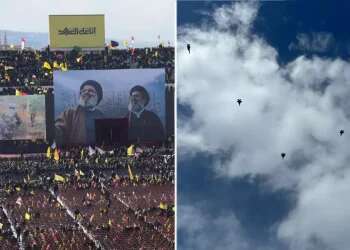
One attendee who declined to provide their name claimed to know Nasrallah, describing him as "a hero" while emphasizing they were "not a Hezbollah member."
In response to the booms overhead, crowds started chanting "Death to Israel". The venue was meticulously prepared, with large screens erected in the center and separate areas designated for men and women, accommodating 20,000 and 30,000, respectively. Additional space in parking lots was arranged for 30,000 more attendees.