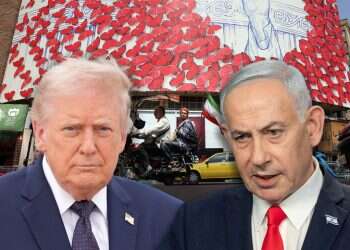
Two weeks ago, German President Frank-Walter Steinmeier met with his Belarusian colleague Alexander Lukashenko, who is known as "Europe's last dictator." Lukashenko surprised his guest with some keen insights about the summit between U.S. President Donald Trump and Russian President Vladimir Putin, which takes place in Helsinki on Monday.
"Trump hates the European Union. Putin wants to see a weakened EU. Any increased closeness, even superficial, between Russia and the U.S., won't be good for Europe," Lukashenko said.
The president of Belarus is seen by many as a puppet of the Russian government, mainly because of his country's economic dependence on its larger neighbor. Lukashenko says he is preventing democratic reform out of fear that Moscow will exploit any change to the style of his regime to revoke the independence of Belarus and make it a satellite state, as it has done with Ukraine, Armenia, and Georgia. Lukashenko is worried that the Helsinki summit might be "too successful," at his expense.
There is concern in the rest of Europe's capitals, too, that the Russian and U.S. presidents will reach understandings that will destabilize Europe and the status of the EU. And not for nothing: For years Russia has been working to weaken the EU by encouraging political forces across the continent – on the Right and the Left – who oppose the idea of "the United States of Europe." Trump and his people, for their part, support Brexit and are drawing closer to populist right-wing parties that want to prevent the EU from becoming a diplomatic superpower. The Trump administration is trying to wipe out the "Obama legacy" on the other side of the Atlantic as well as at home and turn Europe conservative and "Republican."
It looks like Trump and Putin aspire to restore the U.S. and Russia to their former glories and cut Europe down to size as dependent on the grace of Washington and Moscow. Neither of these two leaders has forgiven Europe for its moral superiority and preaching to them about human rights violations rather than thanking them for saving it in World War II. The European member states slapped sanctions on Russia for annexing Crimea and invading Ukraine and banded together to counteract American sanctions against Iran. Both Putin and Trump want to remind Europe of their natural greatness.
Trump has no illusions about Putin and he has no intention of handing him Europe. The two leaders might decide to divvy up areas of influence. Ukraine will be the first to feel the effects. But Trump's desire to shake up the foundations of the NATO alliance demonstrate his intentions to require the Europeans to step up their military deterrence against Russia and help the U.S. economy – by acquiring advanced American weapons systems, among other things.
The host of the summit, Finland, has actually understood Trump's messages: Although Finland is not a NATO member and is proud of its neutrality, in the past few months it has increased its defense coordination with the U.S.