The Middle East is becoming a giant chessboard of competing alliances. But placing powerful pieces on the board does not mean they will move when the game turns dangerous.
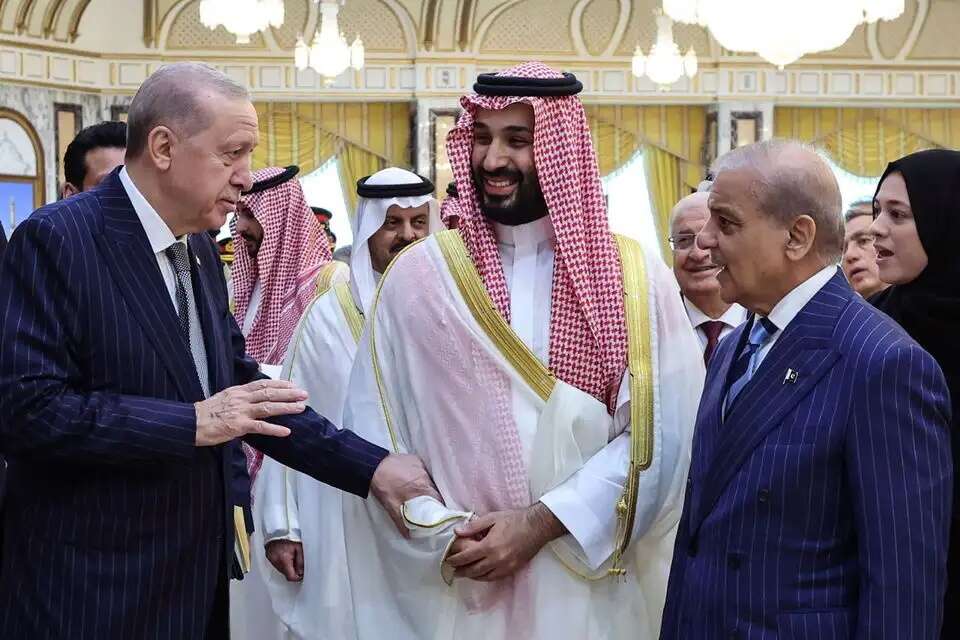
On August 7, 2026, Saudi Arabia, Turkey and Pakistan signed the Mecca Joint Defence Agreement, promising to regard an armed attack against one signatory as an attack against all three.
On paper, the position looks formidable. Saudi Arabia brings financial power and strategic geography, Turkey has NATO's second-largest army and a sophisticated defence industry, and Pakistan brings military experience and the nuclear capability of the Muslim world's only nuclear-armed state.
Turkish Foreign Minister Hakan Fidan described the commitment as technically equivalent to NATO's Article 5. But there are no clear troop commitments, timetable for intervention or definition of what kind of attack would trigger a military response. The real test of an alliance is not the communiqué. It is the first crisis.
When the first piece is challenged
That test came almost immediately. Two days after the agreement was signed, the Houthis claimed responsibility for a drone attack on Saudi Aramco's Jazan refinery. The fire was contained and no injuries were reported, but the attack raised an obvious question: what, exactly, are Turkey and Pakistan now expected to do? The three countries have military power. The question is what they can actually do with it together.
Nothing publicly available confirms that Pakistan has extended its nuclear umbrella to Saudi Arabia or Turkey. Nor does Turkey's NATO membership protect its new partners. For those capabilities to deter an adversary, the three countries need to share intelligence, plan together and be willing to act.
History shows why this matters. When Iraq invaded Kuwait in 1990, the United States assembled a coalition and deployed forces. After the 2019 attacks on Saudi oil facilities at Abqaiq and Khurais, Washington reinforced Saudi defences but did not retaliate directly against Iran. American military power was not in doubt. The willingness to use it was. What happens next matters most. Will the three countries create a joint command, share early-warning data and decide what kind of attack requires military action? Without those mechanisms, the agreement leaves plenty of room for interpretation. A powerful piece matters only if the other side believes it is prepared to move.
The Turkish question
Saudi Arabia must also ask how closely its long-term interests align with Turkey's. The two may share threats today while competing for leadership in the Muslim world tomorrow. The Ottoman Empire controlled the Hejaz, including Mecca and Medina, for four centuries. Today, Ankara wants a greater leadership role, while Riyadh derives enormous influence from its position as custodian of Islam's two holiest sites.
This is not an argument that Turkey wants to control the holy cities. Riyadh and Ankara can cooperate today and still compete for influence tomorrow.
Israeli media reports have also claimed that Turkish officials advised Saudi Arabia to treat an agreement with Israel as a tactical maneuver rather than genuine peace, aimed at lowering Israel's guard while buying time for a future confrontation. The claim has not been independently verified. If true, it gives Riyadh another reason to question Ankara's long-term intentions.
A different model
Israel's relationship with the United Arab Emirates offers a different model. Their ties began with the Abraham Accords but developed into defence procurement, intelligence cooperation and operational assistance. In 2026, Israel reportedly sent Iron Dome batteries and personnel to help defend the UAE against Iranian attacks. This is not an Article 5-style guarantee. But when a concrete threat emerged, Israel did more than issue a communiqué. It moved a piece onto the board.
Saudi Arabia is a different case. A relationship with Israel cannot rest on security cooperation alone. It also has to make political and cultural sense in Riyadh. In Surah Al-Ma'idah 5:21, Moses tells the Children of Israel to enter the "Holy Land which Allah has destined for you." While this is a direct Quranic endorsement of Israel ("Palestine" is not mentioned in the Quran) Muslim scholars of various traditions differ over the verse's implications. The verse itself places a connection between the Children of Israel and the Holy Land within Islamic tradition. That does not implicitly require Riyadh to accept every Israeli policy or abandon its support for Palestinian statehood. But it may provide an Islamic historical framework for pragmatic relations.
Then there is money. The India-Middle East-Europe Economic Corridor is intended to connect India, the UAE, Saudi Arabia, Jordan, Israel and Europe through ports, railways, energy links and digital infrastructure. These are not merely commercial projects. They are strategic squares on the regional chessboard. If Saudi assets increasingly depend on infrastructure connected to Israel, Israel has a reason to protect those corridors. Riyadh, in turn, has a reason to value the Israeli capabilities that help keep them secure.
Economic ties will not prevent every conflict. But they make conflict more expensive and give both sides something tangible to protect. The old logic is familiar: "The enemy of my enemy is my friend." But there is another way to think about it: "Your security protects my assets, and my assets give me a reason to protect you."

When powerful pieces actually move
The Mecca agreement should not be dismissed. Pakistan's nuclear capability, Turkey's armed forces and Saudi Arabia's capital give it considerable potential. But it is not yet a ready-made Muslim NATO. For deterrence to work, an adversary needs to know how the members will respond, how quickly and whether they are actually prepared to act.
That brings us back to the chessboard. In chess, the strongest position is not necessarily the one with the most powerful pieces. It is the one in which those pieces protect one another. A treaty can place powerful pieces on the board. A real alliance makes sure they are prepared to move. And the strongest alliances are those in which both sides have too much to lose by standing still.
Liron Rose is a Major (Res.) in Israeli Intelligence, a tech entrepreneur and investor, creator and host of the podcast "Ha-Yanshuf" (The Owl), an author and a chess player.
Amit Shabi is a former analyst in Intelligence Unit 8200, an investment and capital markets professional, author of several finance books and a competitive chess player.