Israel Hayom is a media organization founded on the belief that the Israeli public deserves better journalism—more balanced, more accurate, and more reliable. Journalism that speaks rather than shouts. Journalism that is trustworthy, objective, and matter-of-fact. A different kind of journalism, offered free of charge. The first print edition was published on July 30, 2007, and in 2010 Israel Hayom became the Israeli newspaper with the highest weekday readership. The newspaper’s publisher is Dr. Miriam Adelson. Its Editor-in-Chief is Omar Lachmanovitch, and its founding editor is Amos Regev. Israel Hayom’s Hebrew and English websites, as well as its Android and iOS applications, provide around-the-clock news coverage, exclusive content, breaking news and updates, analysis and commentary, video, podcasts, and live broadcasts. The digital platforms of Israel Hayom include news and opinion channels covering culture and entertainment, lifestyle, technology, sports, business and consumer affairs, health, military affairs, food, Judaism, tourism, and automobiles. In 2021, a new Hebrew-language website and mobile application were launched to provide users with a fast, up-to-date, secure, and convenient experience. The content of the newspaper’s print edition is also available online through a daily digital edition and can be received via newsletter. “The Israel Hayom Clique,” the publication’s exclusive benefits club, offers website users discounts and special promotions on products and services. Israel Hayom welcomes feedback, criticism, and suggestions for improvement from its readers. You can contact the organization by email at hayom@israelhayom.co.il

Tuesday Oct 6, 2026
NEWSLETTER
www.israelhayom.com
  • Home
  • News
    • Israel
    • Israel at War
    • Middle East
    • United States
  • Opinions
  • Jewish World
    • Archaeology
    • Antisemitism
  • Lifestyle
    • Food
    • Travel
    • Fashion
    • Culture
  • Magazine
    • Feature
    • Analysis
    • Explainer
  • In Memoriam
www.israelhayom.com
  • Home
  • News
    • Israel
    • Israel at War
    • Middle East
    • United States
  • Opinions
  • Jewish World
    • Archaeology
    • Antisemitism
  • Lifestyle
    • Food
    • Travel
    • Fashion
    • Culture
  • Magazine
    • Feature
    • Analysis
    • Explainer
  • In Memoriam
www.israelhayom.com
Home Commentary

The Israeli take on anxiety

Israelis unwillingly became experts in balancing a constant existential threat with an effort to maintain normalcy. What's our "secret"?

by  Adi Nirman
Published on  10-09-2024 04:30
Last modified: 10-09-2024 13:29
The Israeli take on anxietyAmir Cohen/REUTERS

Two Israeli women take cover as a siren sounds warning of incoming rockets near the southern city of Ashkelon | Photo: Amir Cohen/REUTERS

Share on FacebookShare on Twitter

'Tis the season – the blazing sun and summer heat gave way to yellow leaves and colder weather, followed by the holiday season. But for Israelis, October marks a somber milestone – an entire year has passed since Hamas' deadly attack on Oct. 7, an attack that has changed our lives as we knew them forever.

As Israel commemorates Oct. 7's first anniversary, the war is far from over. 101 hostages are still held in Gaza for over 365 days, Israel has commenced its ground offensive on the northern front, citizens are still displaced and rockets are still piercing Israel's skies, with Iran's unprecedented ballistic missile attack being the "icing on the cake." 

And yet, after all this chaos, somehow the world continues to spin; the sun continues to shine; and Israelis move forward. For a whole year, we have been burdened with balancing a continuous existential threat with a need to maintain somewhat of a routine. What makes us such "experts" in doing that?  

As a matter of fact, we have been burdened with this task for generations, and according to Digital Psychologist Liraz Margalit, this is precisely the secret to Israeli society's resilience.

"This is an ability that has developed in us gradually. If I compare the pace of events in Israel to the rest of the world, it's no wonder we have news every half hour – the volatility here is unlike anywhere else," she explained.  "When you're exposed to such an environment from a young age, you learn to cope with such events, both big and small." 

Essentially, what Margalit is saying is it's as if our entire lives have prepared us for this kind of coping, "Which sounds terrible when you think about it," she reflected. "We live dealing with existential threats and constant anxiety. For example, on Oct. 7, there was this shocking statement by the residents of the south who initially said, 'We thought it was just rockets.' Where else in the world would people say, 'Oh, it's just rockets'? We're much more accustomed to dealing with threats compared to the rest of the world."

It is, quite astonishingly, common in Israel to experience rounds of conflict every few years, either on the southern or northern front. Rockets have essentially become a routine matter, as well as terrorist attacks. "It hurts us, but we're already used to it," Margalit said, explaining this pattern of behavior: "This is a biological mechanism called habituation. Take COVID-19 for example – at first, we were very anxious, but anxiety and fear started to decrease as it became our reality." 
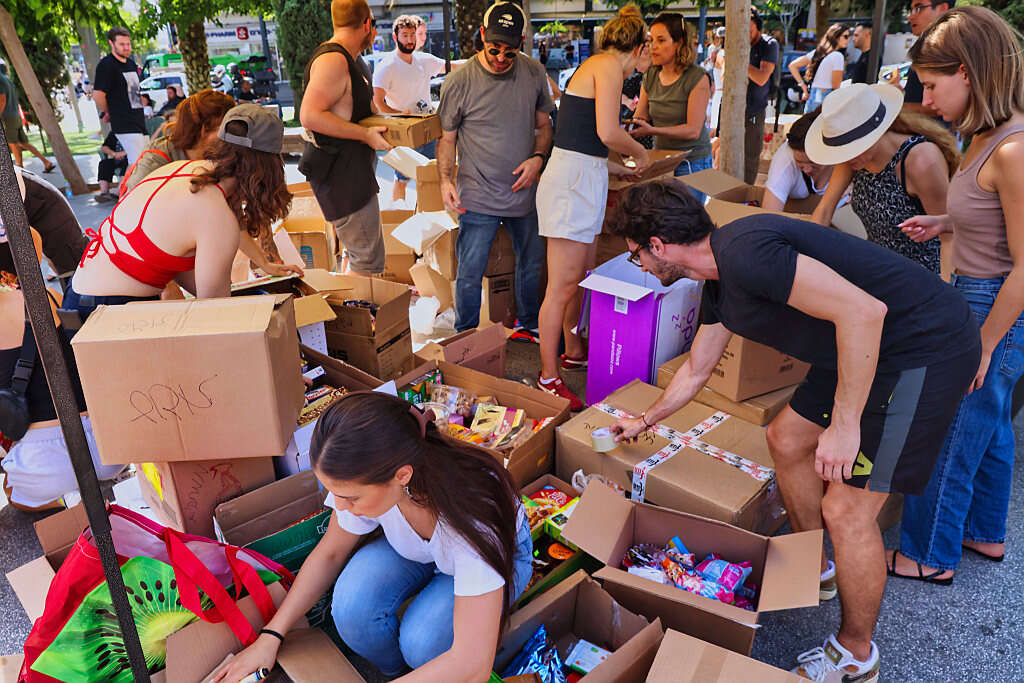
Israelis packing food parcels for residents of southern Israel and IDF soldiers at Dizengoff Square in Tel Aviv, the day after Hamas' surprise attack on Israel on Oct 7. Photo credit: Yehoshua Yosef Yehoshua Yosef

Countering my mistaken impression that Israelis develop apathy to cope with difficult events, Margalit explained that as we continue to live with ongoing stressors, the body, ironically, eventually calms down, since it can't remain in a state of anxiety indefinitely. "It's a survival mechanism, an adaptive one. When we compare Israel to other places, our threshold is much higher; it takes a lot more to throw us off balance," she concluded.

Survival mode sounds just about right for describing life in Israel, but it manifests differently than one might initially expect. Rather than hiding away at home, you see Israelis out and about, even at times of prominent escalation. This demonstrates resilience like no other, refusing to surrender in the face of fear, yet it was important for Margalit to emphasize that as much as it might be perceived as the perfect machoism or invulnerability, resilience is actually about flexibility – the ability to adapt to changing circumstances. 

This is quite a jarring realization, as our natural instinct is to push back against challenging situations we encounter. When facing ongoing difficult circumstances, we often try to control every possible aspect to cope. However, it turns out that true resilience and the ability to handle anxiety are not measured by how much we fight against our situation, but by our capacity to adapt, to flex "like rubber," as Margalit said – adjusting to circumstances beyond our control.

However, extreme events or an ongoing reality marred by pain can eventually lead to a breaking point – even if you are fortunate enough not to live in a conflict zone – with anxiety emerging as one of the most common mental health challenges in the general population. In that case, speaking with a professional or simply writing down our feelings can be very helpful, according to Margalit. "It may sound cliché, but it's backed by science – when we take our disorganized feelings and put them into words on paper, it creates distance from those emotions. We can see that our feelings are manageable and controllable. This act alone can bring tremendous relief."

Another technique psychologists recommend is performing a ritual – writing down all negative thoughts by hand on paper and then burning that note.

"When people I work with start journaling for the first time, whether due to anxiety, heartbreak, or any other issue, it's chaotic at first," Margalit added, "But by the second or third day, they start feeling better, all through this repetitive writing process. It helps create order within our emotions, which is why it's so effective." 

Creating a sense of order seems like a distant dream in Israeli reality. The same applies to anyone on the planet who has ever experienced anxiety of any kind. But if there's one thing Israeli society excels at – and something the world can benefit from learning – is standing firm in the depths of chaos. Why? For one seemingly simple reason – as Golda Meir once said, "I guess we have no choice." The Israeli take on anxiety is about believing you'll ultimately prevail.

Tags: anxietyGaza WarIsrael

Related Posts

Flydubai co-pilot allegedly plotted to crash jet into Tel Aviv skyscrapers

Why does terrorism keep catching Israel by surprise?

by Prof. Zaki Shalom and Prof. Kobi Michael

No security system can prevent every act of terrorism, but security depends on asking what we have failed to imagine....

With or without the US: The potential timeline for a strike in IranReuters

With or without the US: The potential timeline for a strike in Iran

by Lilach Shoval

At present, operational sources in the IDF emphasize that the IDF and the US military remain in extremely close intelligence...

The world is rewriting the rules of genocide, Israel is the targetAFP

The world is rewriting the rules of genocide, Israel is the target

by Yuval Elbashan

An International Court of Justice ruling on a case ostensibly unrelated to Israel, could redefine genocide in a way that...

Menu

Analysis 

Archaeology

Blogpost

Business & Finance

Culture

Exclusive

Explainer

Environment


Features

Health

In Brief

Jewish World

Judea and Samaria

Lifestyle

Cyber & Internet

Sports


Diplomacy 

Iran & The Gulf

Gaza Strip

Politics

Shopping

Terms of use

Privacy Policy

Submissions

Contact Us

About Us

The first issue of Israel Hayom appeared on July 30, 2007. Israel Hayom was founded on the belief that the Israeli public deserves better, more balanced and more accurate journalism. Journalism that speaks, not shouts. Journalism of a different kind. And free of charge.

All rights reserved to Israel Hayom

Hosted by sPD.co.il

  • Home
  • News
    • Israel at War
    • Israel
    • United States
    • Middle East
    • Sports
  • Opinions
  • Jewish World
    • Archaeology
    • Antisemitism
  • Lifestyle
    • Food
    • Travel
    • Fashion
    • Culture
  • Magazine
    • Feature
    • Analysis
    • Explainer
    • Environment & Wildlife
    • Health & Wellness
  • In Memoriam
  • Subscribe to Newsletter
  • Submit your opinion
  • Terms and conditions

All rights reserved to Israel Hayom

Hosted by sPD.co.il

Newsletter

[contact-form-7 id=”508379″ html_id=”isrh_form_Newsletter_en” title=”newsletter_subscribe”]

  • Home
  • News
    • Israel at War
    • Israel
    • United States
    • Middle East
    • Sports
  • Opinions
  • Jewish World
    • Archaeology
    • Antisemitism
  • Lifestyle
    • Food
    • Travel
    • Fashion
    • Culture
  • Magazine
    • Feature
    • Analysis
    • Explainer
    • Environment & Wildlife
    • Health & Wellness
  • In Memoriam
  • Subscribe to Newsletter
  • Submit your opinion
  • Terms and conditions

All rights reserved to Israel Hayom

Hosted by sPD.co.il