Friday May 22, 2026
NEWSLETTER
www.israelhayom.com
  • Home
  • News
    • Israel
    • Israel at War
    • Middle East
    • United States
  • Opinions
  • Jewish World
    • Archaeology
    • Antisemitism
  • Lifestyle
    • Food
    • Travel
    • Fashion
    • Culture
  • Magazine
    • Feature
    • Analysis
    • Explainer
  • In Memoriam
www.israelhayom.com
  • Home
  • News
    • Israel
    • Israel at War
    • Middle East
    • United States
  • Opinions
  • Jewish World
    • Archaeology
    • Antisemitism
  • Lifestyle
    • Food
    • Travel
    • Fashion
    • Culture
  • Magazine
    • Feature
    • Analysis
    • Explainer
  • In Memoriam
www.israelhayom.com
Home Commentary

Israel's response to Houthis came too late

Airport interception failure exposes the price of containment policy while the test of Israel's strategy awaits in its response to future attacks from Yemen.

by  Zvika Haimovich
Published on  05-06-2025 09:00
Last modified: 06-10-2025 16:32
Israel's response to Houthis came too late

A person rides a motorcycle decorated with mock missiles along a street in Sana'a, Yemen, on May 5, 2025 (Photo: Yahya Arhab/EPA)

Share on FacebookShare on Twitter

Since fighting resumed in Gaza, the Houthis have increased their attacks against Israel to unprecedented levels, all while the Americans conduct an aggressive air campaign as Israel (at American insistence) focuses on defense.

A fine line exists between containment and restraint versus attack and deterrence, and when results (not intentions) are what matter, it was clear this was only a matter of time. After all, defense is never airtight, and 100% effectiveness is impossible, even though Israel's defensive systems provide security at impressive rates.

The interception failure at Ben-Gurion International Airport came at the most inconvenient timing and location for Israel, right after flights resumed to Israel and at the strategic site of the country's only aerial gateway, leaving no choice but to respond. The response came too late, was forced, and I risk saying it won't bring significant change in Houthi behavior.
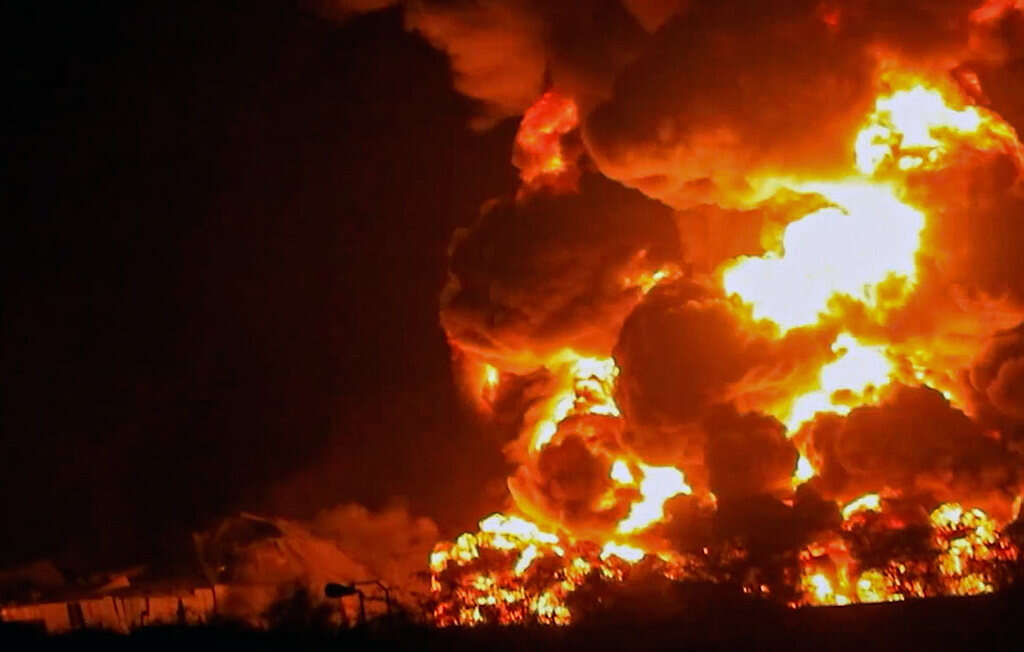
Fires erupted in the Bajil cement factory after Israeli airstrikes targeted it on May 5, 2025 in Hodeidah, Yemen. Photo credit: Getty Images

Israel's security doctrine cannot rely on outsourcing the prevention of threats to other countries, certainly not for extended periods. This projects weakness throughout the region, particularly to Iran. The test of Israel's strategy will be in the response following the next attack from Yemen, which will unfortunately come.

Israel's response comes against the backdrop of expanded fighting in Gaza and at a sensitive stage in American negotiations with Iran regarding its nuclear program. Both factors affect the ability to maintain a continuous response and prevention against an additional distant theater – Yemen. The end of restraint has been forced by circumstances (the failed interception at Ben Gurion Airport) rather than through a comprehensive strategy.

Only a balanced combination of defense that thwarts threats and provides decision-makers with room to take offensive initiative at the place and time of their choosing, without other constraints, should guide the cabinet in formulating policy during the current campaign, which still faces many challenges both near and far.

Related Posts

IDF chief: Israel holds more 'surprise moves' as war enters next phase

Iran lowers the volume on Israel, and there is a reason for that

by Beni Sabti

A shift in Tehran's tone toward Israel during the recent days of calm, with fewer verbal attacks on Jerusalem. Israel...

EU designate Iran’s Revolutionary Guards as a terrorist organization

Iran's terror reach exposes Europe's dangerous weakness

by Dr. Yossi Mansharof

The arrest of a senior Iranian operative shows that Tehran directed nearly 20 attacks on European and US soil in...

It is time for Israel to start fighting like a startup nation

To counter Hezbollah's drone threat, Beirut must be brought into the equation

by Meir Ben Shabbat

Israel must make Hezbollah question whether using this weapon is worth it. It can achieve this only by bringing down...

Menu

Analysis 

Archaeology

Blogpost

Business & Finance

Culture

Exclusive

Explainer

Environment


Features

Health

In Brief

Jewish World

Judea and Samaria

Lifestyle

Cyber & Internet

Sports


Diplomacy 

Iran & The Gulf

Gaza Strip

Politics

Shopping

Terms of use

Privacy Policy

Submissions

Contact Us

About Us

The first issue of Israel Hayom appeared on July 30, 2007. Israel Hayom was founded on the belief that the Israeli public deserves better, more balanced and more accurate journalism. Journalism that speaks, not shouts. Journalism of a different kind. And free of charge.

All rights reserved to Israel Hayom

Hosted by sPD.co.il

  • Home
  • News
    • Israel at War
    • Israel
    • United States
    • Middle East
    • Sports
  • Opinions
  • Jewish World
    • Archaeology
    • Antisemitism
  • Lifestyle
    • Food
    • Travel
    • Fashion
    • Culture
  • Magazine
    • Feature
    • Analysis
    • Explainer
    • Environment & Wildlife
    • Health & Wellness
  • In Memoriam
  • Subscribe to Newsletter
  • Submit your opinion
  • Terms and conditions

All rights reserved to Israel Hayom

Hosted by sPD.co.il

Newsletter

[contact-form-7 id=”508379″ html_id=”isrh_form_Newsletter_en” title=”newsletter_subscribe”]

  • Home
  • News
    • Israel at War
    • Israel
    • United States
    • Middle East
    • Sports
  • Opinions
  • Jewish World
    • Archaeology
    • Antisemitism
  • Lifestyle
    • Food
    • Travel
    • Fashion
    • Culture
  • Magazine
    • Feature
    • Analysis
    • Explainer
    • Environment & Wildlife
    • Health & Wellness
  • In Memoriam
  • Subscribe to Newsletter
  • Submit your opinion
  • Terms and conditions

All rights reserved to Israel Hayom

Hosted by sPD.co.il