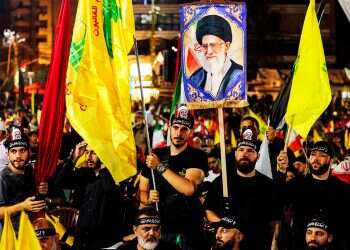
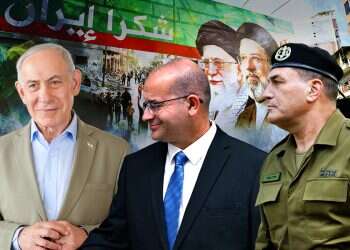
"During the war, everyone saw that Iran was attacking Arab states – and that goes beyond 'Muslims against Jews and Israel,'" Amine Drissi Boutaybi, a Moroccan author and entrepreneur, said in an interview with Israel Hayom. He is currently publishing a new book aimed at combating antisemitism and breaking down barriers between Jews and Muslims.
"When Iran attacks Muslim-majority states, it changes everything on the ideological level. We can see that Arab states face a shared threat – and that threat is Iran," Boutaybi explained. On the relationship between Iran's regime and Morocco, he said, "When the Shah was in power, there was a brotherly relationship between Iran and Morocco – a bond of friendship between the Shah and Morocco's late King Hassan II. But after the 1979 revolution, many problems arose. The first was that Morocco is a friend of the Gulf principalities and kingdoms. So relations between Morocco and Iran deteriorated very quickly. The second problem was that, according to intelligence reports, Iran tried to promote a coup against the late King Hassan II, who even said, 'If Khomeini is a Muslim, then I am not a Muslim'" – a reference to the first leader of Iran's Islamist regime.
He added, "The third problem is that, according to intelligence reports, the Moroccan government knows that Iran, through Hezbollah, financed the Polisario Front in the south of Morocco. Since that became known in 2009, ties were severed completely, and there were no longer any diplomatic relations. Relations were already strained before the war and worsened during it. Morocco was also the first country to condemn the fact that Iran attacked the Gulf states."
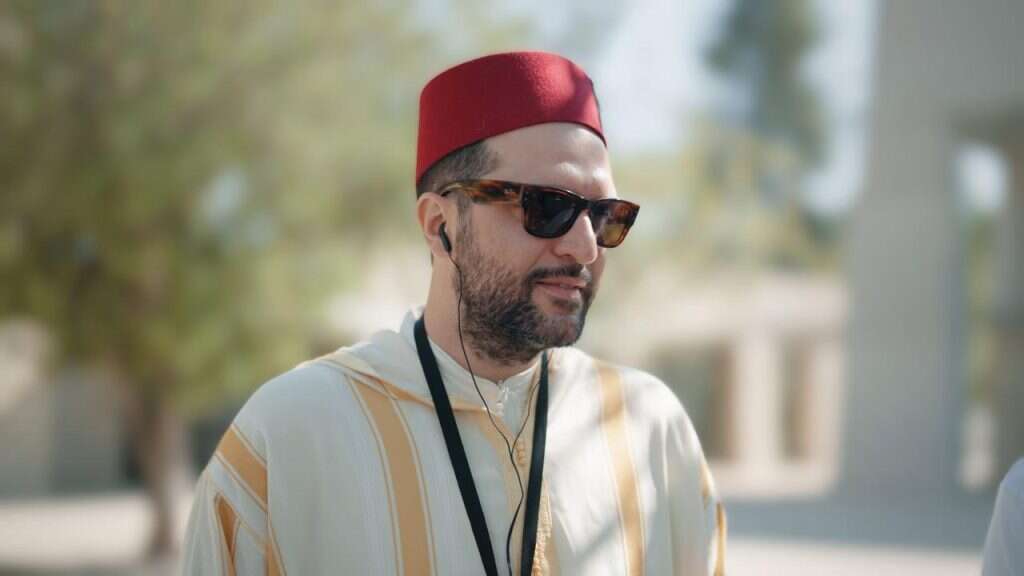
Boutaybi is one of the most prominent social media activists today advocating for relations with Israel and advancing normalization. Under the name "The Pink Tarboush", he leads a large digital community with hundreds of thousands of followers and millions of views per month.
His accounts are dedicated to Moroccan culture, its local history and identity – and especially to the Moroccan Jewish community. His book, "Morocco, the Jews and Israel – Memory and Influence," contains 162 questions and answers covering thousands of years of Jewish life in Morocco, including the history of the rabbis, the Amazigh tribes, the Mellah (the traditional Jewish quarter), and King Mohammed V's refusal of Vichy France's demands during the Nazi era, among other topics.
He is currently striving for all Moroccans to learn about the Jewish connection to the kingdom and to fight antisemitism. With the current book, he is targeting primarily the Moroccan diaspora in Europe that speaks French, but he plans to publish it in additional languages – Arabic, English, and of course Hebrew. He has two additional goals: to clarify the importance of relations between Israel and Morocco, and to reduce the hostility some Moroccans harbor toward Israel.

"Moroccans living in France, Belgium, and the Netherlands need to be far more aware. Culturally, they are not like Moroccans in Morocco. Unfortunately, the diaspora communities there are more exposed to Islamism – Wahhabism, the Muslim Brotherhood," he said. According to him, the situation in the Kingdom of Morocco is entirely different. Still, he aspires for as many Moroccans as possible to learn about the country's Jewish history.
One of the questions in the book, for example, deals with two distinct populations of Jews in Morocco – the Jews who lived in Morocco before the arrival of Islam and the Jews expelled from Spain in 1492 who later settled in Morocco. Other questions deal with Israel, including the approximately one million Israelis of Moroccan origin. "My dream is that every Moroccan will be able to learn about Israel and about the Jews through this book."
Boutaybi's activism brought him to a visit to the Auschwitz extermination camp as part of the March of the Living, which took place this month. "I had already been to Auschwitz ten years ago, but that was out of curiosity – because I had heard so much about Auschwitz, and it was truly painful to see. But this time was different, because I was accompanied by so many people, so the emotions were much stronger. I don't know why. I felt exhausted and sad after the visit to Auschwitz," he said.
"I was there wearing my tarboush, and the message I wanted to convey was to recall that Morocco's late King Mohammed V saved the Jews during World War II when he refused Vichy France's demands. There were a quarter of a million Jews there. I was quite anxious, to tell the truth. I couldn't stop thinking about what would have happened if I had been there, if I had been Jewish," the Moroccan author shared.