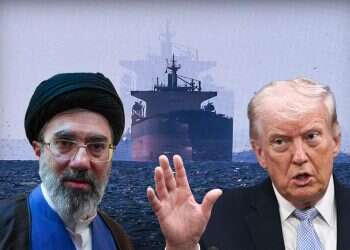
US President Donald Trump announced overnight Saturday that an agreement with Iran has largely been reached and a regional memorandum of understanding on peace, and that discussions were now underway on the final aspects and details of the understandings between the US, Iran and other countries in the region.
A diplomatic source in the region told Israel Hayom that Trump had also updated Gulf leaders that Iran had agreed in principle to hand over its enriched uranium, which would take place in the final stage of the negotiations. In addition, Iran has agreed to a ban on enrichment for a long period of time and to international supervision. Trump also promised that US forces would remain in the region "as long as necessary."
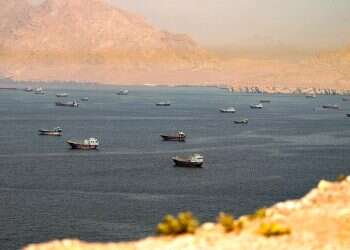
According to the source, the issue of the Strait of Hormuz has become one of the main conditions in the contacts between the US and Iran. Under the emerging understandings, Tehran has pledged to keep the Strait of Hormuz fully open, with no restrictions on the movement of ships and oil, as a condition for the unfreezing of frozen Iranian funds and progress on an agreement with Washington. At the same time, Trump made clear to Gulf leaders and Prime Minister Benjamin Netanyahu that US forces would remain in the region "as long as necessary," among other things to ensure freedom of navigation in the Gulf.

In the statement he issued after talks held in the Oval Office at the White House, Trump said a series of leaders from the Middle East and the Muslim world had taken part, including Saudi Crown Prince Mohammed bin Salman Al Saud, United Arab Emirates President Mohammed bin Zayed Al Nahyan, Qatari Emir Tamim bin Hamad Al Thani, Turkish President Recep Tayyip Erdogan, Egyptian President Abdel Fattah el-Sisi, Jordan's King Abdullah II and Bahrain's King Hamad bin Isa Al Khalifa.
"Final aspects and details of the Deal are currently being discussed, and will be announced shortly," Trump said. He also noted that he had held a separate call with Prime Minister Benjamin Netanyahu, which he said "went very well." Trump added that one of the central components of the emerging agreement was the reopening of the Strait of Hormuz, the strategic shipping route that is of global importance to energy markets and international trade.
The statement comes against the backdrop of reports in recent days of significant progress in contacts between the US and Iran, in an effort to reach understandings that would prevent further escalation in the region.
In addition, reports in the US overnight said Iran had pledged to give up its enriched uranium. According to The New York Times, Tehran has agreed in principle to give up its stockpile of highly enriched uranium as part of the understandings between the sides ahead of the emerging agreement.
Fars: Hormuz will remain under Iranian control
After the president's post, the Fars news agency, which is close to the Islamic Revolutionary Guard Corps, rejected the claim that the Strait of Hormuz would return to its previous state, even though the president stated simply that it would be "opened." According to Fars, even if an agreement is signed, management of the strait, including determining the route of passage, the timing of passage and the issuing of permits, will remain solely in Iran's hands. Fars further claimed that the nuclear issue had not been discussed at all at this stage of the contacts, and that American officials had made clear to Iran in several messages that Trump's tweets were aimed at US public opinion.

Contrary to the report by Tasnim, according to a report in The New York Times, Iran has agreed in principle to give up its stockpile of enriched uranium as part of the emerging agreement with the US. However, the sides have not yet agreed on how the move would be carried out, and discussion of the matter has been postponed to the next round of talks. As stated, the Iranian side denies the claims.
"Great appreciation" for Trump
Saudi Arabia said of the call with President Trump and regional leaders that Saudi Crown Prince Mohammed bin Salman, the US president, the king of Bahrain, the emir of Qatar, the president of the United Arab Emirates, the king of Jordan, the president of Egypt, the president of Turkey and Pakistan's chief of army staff held a joint phone call to discuss the latest regional developments.
They expressed deep appreciation for President Trump's leadership and his commitment to consultation and coordination with the region's leaders. They also praised the mediation efforts of the Islamic Republic of Pakistan, as well as efforts led by the State of Qatar, aimed at reaching an agreement that would bring an end to the escalation and strengthen security and stability in the region.
Pakistani Foreign Minister Mohammad Ishaq Dar, who arrived in Tehran over the weekend with a Pakistani delegation for talks on the agreement, said the phone call initiated by the US president was "important" and "constitutes a significant step toward regional peace." He added that "the achievements of the negotiations provide grounds for optimism. A positive and sustainable outcome is within reach. Trump is committed to dialogue and diplomacy."