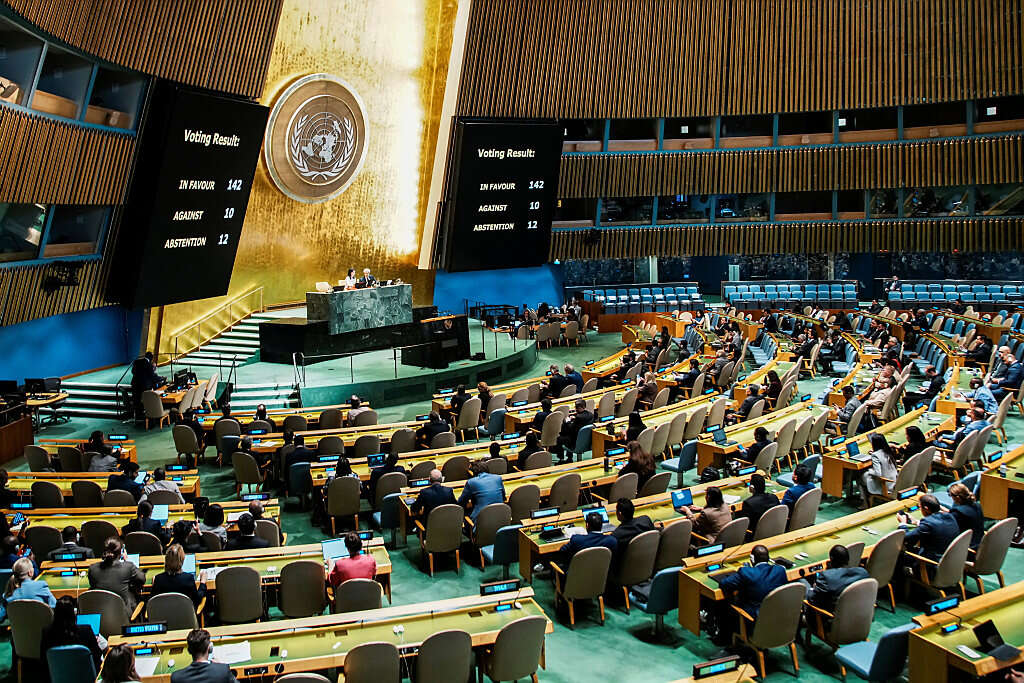
Sitting inside the United Nations building in New York, it is easy to be struck by the weight of what this institution is supposed to represent: peace and security, upholding international law, and protection of human rights.
On May 29, events inside these walls raised serious questions about whether those principles are being honored.
The UN officially added Israel to its blacklist of countries accused of committing sexual violence in conflict zones, specifically naming the Israel Prison Service. The decision has drawn fierce criticism from journalists, politicians across the political spectrum, and leaders of NGOs and think tanks, and for reasons that go well beyond politics.
The newly released independent report Silenced No More adds to that record, compiling survivor testimony and evidence of the sexual violence perpetrated on and after October 7. It is a two-year, 298-page investigation conducted over 1,800 hours and drawing on more than 10,000 photos, videos, and survivor testimonies that details atrocities that are almost impossible to read: men and women (including young girls) subjected to rape, sexualized torture, mutilation, forced nudity, and the desecration of bodies. Parents murdered in front of their children. Victims stripped, violated, filmed, and displayed.
And yet the UN's own report on the conflict claims it "was not able to verify" that Hamas sexually abused Israeli hostages, despite the fact that many hostage testimonies have been made public, and that former Israeli hostages who experienced sexual violence in Hamas captivity have testified before this very institution.
The UN blacklist does include Hamas and other designated terror groups like ISIS and Boko Haram. But placing Israel alongside them on the basis of this report diminishes the depravity of organizations whose signature crimes include mass murder, rape, torture, and hostage-taking.
The UN report cites 31 cases against Israel over three years, nine of which involve rape or gang rape allegations (while others describe threats of rape). Each allegation is serious and warrants investigation, but the scale and evidentiary record differ substantially from claims of systematic, policy-driven sexual violence comparable to that documented in the cases of Hamas or ISIS. Several journalists who examined both the UN allegations and related New York Times reporting, including outrageous claims that Israel trains dogs to sexually assault detainees, concluded that neither the UN report nor the associated opinion journalism established evidence of deliberate, systematic sexual violence as official Israeli policy. Every prison system in the world, including Israel, the United States, and Canada, has documented incidents of abuse. The key distinction is that these countries maintain institutional mechanisms to investigate allegations, prosecute offenders, and hold perpetrators accountable.
The most prominently cited case by those echoing the UN and New York Times allegations is the Sde Teiman detention facility, where a leaked video appeared to show five soldiers sexually assaulting a Palestinian prisoner. Israel's own courts charged the soldiers with severe physical assault. But in March 2026, all charges were dropped. The court claimed that the leak complicated the investigation and was concerned that a fair trial could no longer be guaranteed. To further complicate matters, the detainee had been released to Gaza and was no longer available for cross-examination. Many in Israel are unhappy with the outcome, but the UN cites this as evidence of "a climate of impunity." Israel calls it proof that its legal system works, even imperfectly, under exceptional circumstances.
The most troubling part is that Israel says it provided documents, data, and detailed responses to every claim in the report. It offered UN personnel access to the very sites under investigation. Pramila Patten, the Special Representative of the Secretary-General on Sexual Violence in Conflict and the author of the report, publicly admitted she told Israel she would not visit any detention facility, even if offered access. That is not the behavior of an investigator seeking the truth; it is the behavior of one who has already decided what the truth is.
Meanwhile, 1,500 UN employees in Gaza are currently under investigation for terror ties to Hamas. Nothing, as yet, has been done.
None of this means that every allegation in the UN report is false, or that accountability for abuse in Israeli prisons doesn't matter. But accountability requires consistent standards, honest investigation, and the courage to apply equal scrutiny to all parties, including those the political moment makes it easier to ignore.
The only conclusion is that the UN's objective was not to uncover facts but to reinforce a narrative about Israel. When the body responsible for documenting sexual violence in conflict refuses to visit the sites it is investigating, declines the evidence offered to it, and cannot verify claims in its own report, then what credibility does it have?