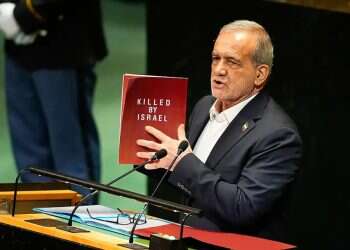
The documentary "NAZA" winning the Special Jury Prize at the Venice Film Festival triggered a wave of outrage in Israel. Prime Minister Benjamin Netanyahu announced that, in response to the film, he would advance legislation against defaming Israel Defense Forces soldiers and the State of Israel; Culture and Sports Minister Miki Zohar called for the filmmakers' citizenship to be revoked; and Deputy Minister in the Prime Minister's Office Almog Cohen called for sanctions against them. Alongside the political reaction, the film also came under fierce criticism from across Israeli society.
Yet alongside the anger and shock, as the familiar cliché goes, "every crisis is also an opportunity." And while NAZA may indeed be creating a crisis for Israel in international public opinion, it also strikes at the heart of the genocide allegations against it.
What exactly is NAZA? The title "NAZA" is itself a Hebrew acronym for nezek agavi, or "collateral damage," the military and legal term for unintended harm to civilians during an attack on a legitimate military target. In the case addressed by the film, namely the war in Gaza, that target is a Hamas operative.

What is genocide?
In December 2023, South Africa brought a case against Israel before the International Court of Justice in The Hague, accusing it of genocide against the Palestinian people. Under the legal definition set out in the 1948 Genocide Convention, genocide does not simply mean mass killing.
The definition requires two elements to exist simultaneously: one of a closed list of prohibited acts, such as killing members of the group or causing them serious bodily or mental harm, together with the specific and distinct intent to destroy a national, ethnic, racial or religious group, in whole or in part, as such. Those final words are not a technical add-on. They are what separates genocide from a war crime and even from mass slaughter.
That intent later became known by the Latin term dolus specialis, which became a cornerstone of international genocide law, including in landmark rulings by the International Criminal Tribunal for Rwanda in 1998 and 1999: an unusually demanding mental element required for the crime of genocide.
The International Court of Justice itself has also set a particularly high evidentiary threshold for establishing such intent. In the 2007 case Bosnia and Herzegovina v. Serbia and Montenegro, the court had to determine whether the campaign of ethnic cleansing carried out by Bosnian Serb forces throughout Bosnia between 1992 and 1995 amounted, taken as a whole, to genocide. The standard it applied was that, when genocidal intent is inferred from a pattern of conduct, the intent to destroy the group must be the only reasonable inference that can be drawn from the acts in question.
Under that test, despite the scale of the war crimes documented across Bosnia, the court found that the specific intent required for genocide had not been established in the incidents it examined, with one exception. That exception was the Srebrenica massacre of July 1995, in which about 8,000 Muslim men and boys were murdered. The men and boys were separated from women, children and the elderly, and the overwhelming majority were executed. The court held that the acts committed at Srebrenica were carried out with the specific intent to destroy, in part, the Bosnian Muslim group.
Historical and legal accuracy, however, requires noting that the court ruled that the acts of the forces that carried out the Srebrenica genocide, the Army of Republika Srpska, could not be legally attributed to the Serbian state itself. It did, however, find that Serbia had violated its obligation to prevent genocide.
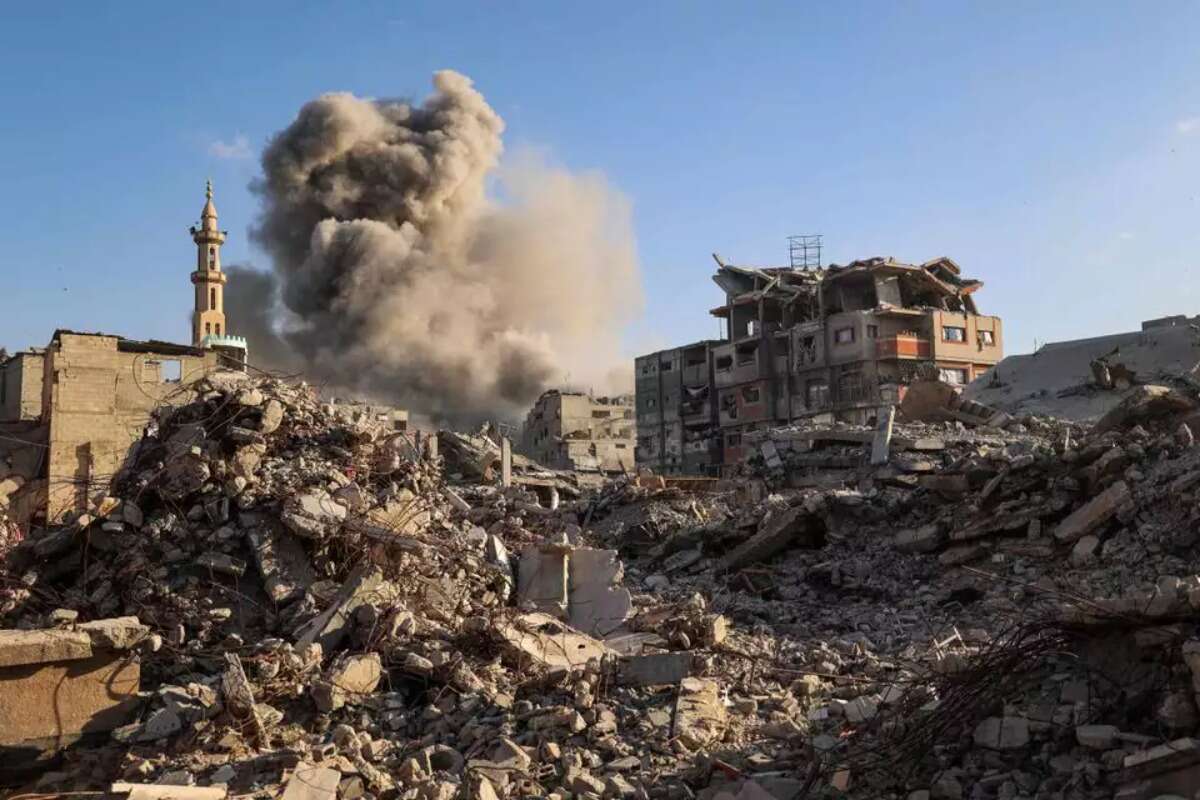
How does NAZA undermine genocide allegations?
The film's basic claim is that the IDF operates a mechanism known as NAZA that assesses in advance, for each target, the maximum number of civilians likely to be harmed in relation to the operational value of eliminating that target, and approves or rejects a strike accordingly. NAZA's accusation against Israel is that the IDF is a "loose cannon," willing to harm a disproportionate number of civilians in order to eliminate a single terrorist.
Even if, for the sake of argument, that description is assumed to be entirely accurate, and even if the IDF approves the killing of terrorists at an excessive cost in civilian lives, this would be powerful evidence against the allegation of genocide. The very concept of "collateral damage" presupposes a process that distinguishes between the intended target and the incidental harm caused by attacking it, sets a ceiling for that harm and examines whether the proposed strike falls within it. That is, in practical terms, the opposite of what genocide is supposed to look like.
Someone seeking to destroy a people seeks to kill as many of its members as possible, without distinguishing between the enemy's fighting forces and its civilian population. The film alleges that the IDF maintains a mechanism that makes distinctions, calibrates expected harm, imposes a ceiling and then determines whether a strike is authorized. No one attempting to carry out genocide would need such a procedure. On the contrary, what the film describes is a system concerned with limiting collateral damage, not one reflecting an intent to destroy a population as such.
That is precisely where what was intended as incriminating evidence becomes potentially exculpatory. An intent to destroy a people as such leaves no room for proportional calculations, numerical ceilings or tiered approvals based on the identity and importance of a target. Such an intent has no need for an approval mechanism of this kind. At a deeper level, the very existence of the system described in the film, even as portrayed in the darkest possible terms, cuts against the mental element that genocide requires.
The timing, in fact, is convenient. The case in The Hague is now well into the written-pleadings stage. Israel submitted its Counter-Memorial in March 2026, including an objection to the court's jurisdiction. South Africa has until Nov. 22, 2027, to submit its Reply, and Israel has until May 22, 2029, to file its Rejoinder.
There is no imminent public hearing at which a dramatic film clip could simply be projected on a screen. Precisely for that reason, however, Israel's legal team has a lengthy window in which to incorporate into its written pleadings the underlying material on which the film is based. Not the movie itself as a cinematic work, but what its 24 witnesses described, read at face value: not through the dramatic editing chosen to support an accusation, but as inadvertent documentation of a mechanism that differentiates between military targets and civilian harm.
Reviews have already described the film in terms portraying it as a devastating exposé of Israeli conduct, and at least one of the people interviewed in it uses the word "genocide" to describe what he witnessed. That makes it all the more important for Israel's lawyers to know how to read those testimonies against the direction in which the film has edited and framed them. Not to refute the moral criticism the film raises, but to demonstrate that the very mechanism it describes is calculated, graduated and subject to numerical ceilings and therefore, as a matter of the legal argument, fundamentally at odds with an intent to destroy a people.
Ultimately, in an ideal world, with an objective court bound by the law, its own precedents and logic, I would quite seriously urge Israel's defense team to screen selected excerpts from NAZA before the court in The Hague, after denying the allegations made in the film, of course. But in a reality in which narrative, emotion and public opinion may well play a major role in the judges' decision, we may have to settle for making the argument in writing.