1.
We have reached the end. An end that is a beginning. Moses completes his mission and Joshua begins his. "The face of Moses was like the face of the sun, and the face of Joshua like the face of the moon." The first stood at the cradle of the nation, led it through the great wilderness, endured its follies and complaints, passed through complex crises with it and watched the generation that left Egypt give way, in the end, to the generation destined to conquer Canaan.
Now the time has come to pass on the rod of leadership.
Moses had to make room, like a father who knows that at this stage of his children's lives, his presence could impair their development. For the nation to advance to the next stage in forming its independent personality, it must detach itself from the umbilical cord of the man who brought it into being.
Jewish psychoanalyst Margaret Mahler described the process through which an infant progresses toward physical and psychological separation from the mother and the construction of a distinct, stable identity with the term "separation-individuation." Psychoanalyst Peter Blos, also Jewish, expanded the theory and applied it to adolescence: Just as an infant must separate from the internal image of the mother in order to become independent, the adolescent must separate from internalized images of the parents in order to build a mature and independent identity.
For this process to succeed, Mahler and Blos emphasized the importance of providing a secure base that enables distance and independence while leaving the parents present and accepting when the adolescent needs them. It is therefore vital that a parent not abandon the adolescent out of anger or anxiety, and certainly not subject him to emotional rejection, thereby suffocating his healthy development.
2.
Moses' presence was crucial for the young nation during its years in the wilderness. Now, as it prepares to enter the land, that presence could hold back its national and spiritual development.
Moses will continue to accompany the people through the Torah, just as our parents accompany us in spirit throughout our lives. Of the five expressions of redemption spoken to Moses in Egypt, he fulfilled four: "I will bring you out", "I will deliver you", "I will redeem you" and "I will take you to Me as a people" (Exodus 6:6-7), at Mount Sinai and through the giving of the Torah. The final stage in the plan, "I will bring you into the land" (Exodus 6:8), will be carried out by his successor.
There is a fundamental difference between existence in the wilderness or in exile, in the biblical "wilderness of the peoples" (Ezekiel 20:35), and the sovereign existence of a people in its own land. That difference requires a different kind of leadership.
What follows is that Moses remains outside the Land of Israel not because of the sin of the Waters of Meribah, whether understood as striking the rock instead of speaking to it or through the many other interpretations of the transgression, but because this is how the sequence of events had to unfold.
Moses' anger at the people in that episode merely clarified the gap between the "man of God" (Deuteronomy 33:1) and the nation. On the surface, the Torah describes a sin. At a deeper level of reality, however, this is the natural progression toward a new stage in which Moses must no longer be physically present.
The children of Israel must develop in their land like "the waters of Shiloah that flow gently" (Isaiah 8:6). Hundreds of years will pass before they consolidate themselves into a kingdom with a centralized government exercising sovereignty across the full expanse of the land.
3.
This double pattern accompanies the Torah from its very beginning: On the surface, there are various causes for events, but deep within history an immense undercurrent is at work, propelling reality toward its fulfillment.
The Torah of Moses teaches us to read history in at least two ways: rationally and spiritually. In the terminology of Rabbi Abraham Isaac Kook, through a causal perspective and a moral perspective.
The causal perspective sees logical regularity in the material world, visible reasons for what happens. For some 2,500 years, Western philosophy has dealt with the logic of cause and effect: Nihil est sine ratione, nothing exists without a reason.
But this approach has an inherent limitation. Logic does not answer everything. We must free ourselves from the "causal distress," as Rabbi Kook calls it, from the logical reading of history, and enter a meta-historical realm in which "moral understanding" operates and laws higher than simple logic prevail.
Under the moral perspective, events are not an accidental chain of "this is what happened," but possess the supra-historical significance of "this is what ought to have happened."
On the surface, Adam sins and eats from the Tree of Knowledge. At a deeper level: "The time had come for the first man to sin." It had to happen that way, so that knowledge would remove humanity from the Garden of Eden and human history would begin, as discussed in our study of Genesis.
On the surface, the brothers sell Joseph into slavery. But deep within reality, the young man's dreams of glory and kingship begin to come true at precisely that moment.
4.
For this reason, Rabbi Chaim ibn Attar, the 18th-century Torah commentator known as the Or HaChaim, writes: "It appears that Scripture intended to praise the man of God, showing the greatness of his deeds."
At the end of the previous Torah portion, the decree preventing Moses from entering the land was mentioned. "If so," ibn Attar writes, one might say that Moses harbored resentment over his death, brought about because of the children of Israel, who prevented him from "crossing into the land for which his soul yearned and pined."
Yet Moses rose above this and blessed them: "And this is the blessing with which Moses, the man of God, blessed the children of Israel before his death" (Deuteronomy 33:1).
The conjunction "and" at the beginning of this verse links the decree of dying there, with the power of the blessing. Moses does not keep a personal score.
Most leaders throughout history did not prepare successors, except within family dynasties. As far as they were concerned, after them came the deluge.
Moses is among the few who trained, during their own lifetime, a successor who was not a family member. He laid his hands upon Joshua before the people and bestowed his authority upon him. He is not called the "man of God" (Deuteronomy 33:1) for nothing. Only an exceptional human being can hand over the keys and make way for the next leader out of a sense of responsibility for his people's future.
5.
"And he said: The Lord came from Sinai, and dawned upon them from Seir; He shone forth from Mount Paran and came from myriads of holiness. From His right hand came a fiery law for them" (Deuteronomy 33:2).
Moses does not begin with the Exodus from Egypt or the parting of the Red Sea, but with the covenant at Sinai, the pinnacle of his life and the eternal bond between the people and their God.
The Torah is a "fiery law" (Deuteronomy 33:2) for them, and is described by the sages as "black fire upon white fire." Great caution is required with this gift, for fire can warm and do good, but it can also burn.
"Indeed, He loves the peoples; all His holy ones are in Your hand, and they were struck at Your feet; they bear Your words" (Deuteronomy 33:3).
Although God loves all peoples, there is one nation whose holy ones are, as it were, in God's hand, close to Him. Earlier in Deuteronomy, Moses elaborated: "The Lord has chosen you ... to be His treasured people from among all the peoples on the face of the earth" (Deuteronomy 7:6).
Election does not mean condescension or "Jewish superiority." The opposite is true. It is a responsibility to spread the message of Torah and morality throughout the world, a mission for which we have paid a heavy price. This is what Moses meant when he said: "And they were struck at Your feet" (Deuteronomy 33:3).
Throughout the generations, Israel has been "struck," meaning continually beaten, "at Your feet," meaning on Your account, for Your sake.
Why?
"They bear Your words" (Deuteronomy 33:3), because they carry Your Torah, the words You spoke to them.
Rabbi Isaac Arama, who lived in the generation of the expulsion from Spain and the destruction of its Jewish communities, wrote with deep emotion:
"'And they,' meaning all the members of this chosen nation, 'were struck at Your feet,' meaning: You kicked them and trampled them beneath Your feet, and despite all this, it, the people of Israel, endures and 'bears Your words' (Deuteronomy 33:3), and will not cease declaring: 'Moses commanded us the Torah, an inheritance of the congregation of Jacob' (Deuteronomy 33:4). In other words: A Jew, either burned or crucified."
During the final century of the Jews' presence in Spain, amid the repeated waves of violence, the cry "the cross or death" echoed again and again, as Jews were confronted with the choice of baptism or death.
It is no coincidence that Arama's Torah commentary is called Akedat Yitzhak, "The Binding of Isaac." Two years after the expulsion, in 1494, he died in Naples. His contemporary Don Isaac Abravanel, who went into exile along with his fellow Jews, wrote in a similar spirit:
"'All His holy ones are in Your hand' (Deuteronomy 33:3), meaning: They are in Your hands, in their holiness. And although they suffer many blows and afflictions, they remain constantly attached to the Blessed One, struck at His feet like slaves at their master's feet. Yet even under the force of those blows, 'they bear Your words' (Deuteronomy 33:3): 'Moses commanded us the Torah' (Deuteronomy 33:4), meaning that the Torah will never depart from their mouths."
And what are we to say, members of a generation of redemption privileged to attain what those holy people could only dream of: to live in our land and in an independent Jewish state?
6.
"Moses commanded us the Torah, an inheritance of the congregation of Jacob" (Deuteronomy 33:4).
A morashah is an inheritance. And yet there is a difference.
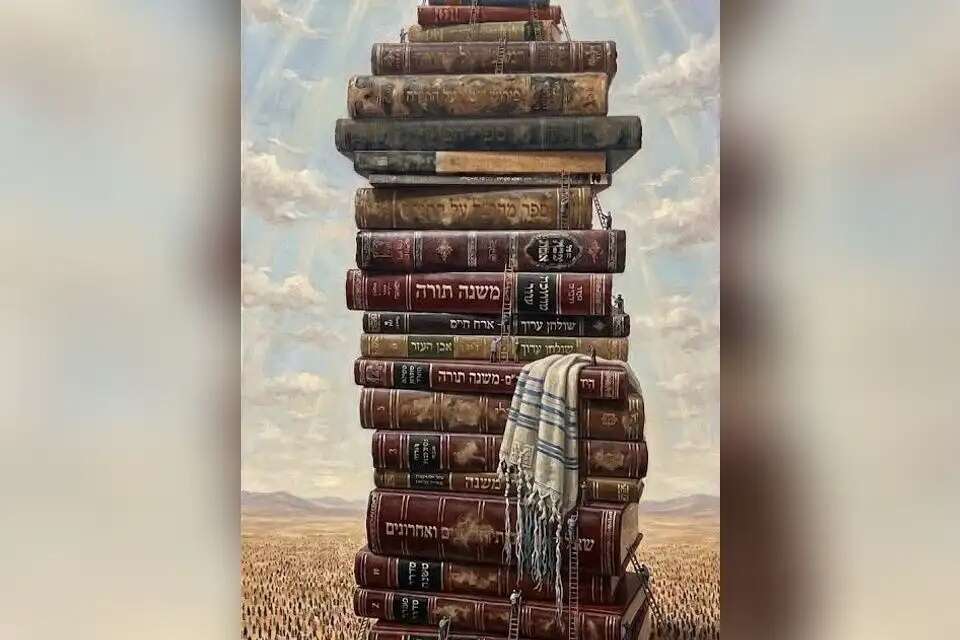
An inheritance passes to descendants in any event by virtue of their natural rights. Morashah, by contrast, is the command to actively pass that inheritance on to future generations, that immense textual and intellectual skyscraper unlike anything any other nation has bequeathed to its descendants.
We have a moral and national obligation to preserve the legacy, study it, delve into it, contribute something of our own and then pass it onward. The idea resembles the difference between saying, "I am Jewish because I was born that way," and saying, "I am Jewish because I choose to be Jewish," and acting to realize that choice.
"Morashah" is also the name of the elementary school whose legacy I have carried with me ever since, and where I spent my first six years of schooling in Amishav, the neighborhood of my childhood (in Petah tikva), where thousands of olim, survivors from Jewish communities across the Diaspora, gathered in the early years of the State of Israel.
7.
Then come the blessings of the tribes, each with its own blessing, and finally the general blessing ahead of the conquest and inheritance of the land:
"He drove out the enemy before you, and said: 'Destroy!'" (Deuteronomy 33:27).
And the promise:
"Israel shall dwell securely, alone; the fountain of Jacob, upon a land of grain and wine" (Deuteronomy 33:28).
The blessing of aloneness resembles Balaam's blessing:
"Behold, a people that dwells alone and is not reckoned among the nations" (Numbers 23:9).
It is a promise that our sages interpreted in several ways: separation from outsiders, who will not dare approach or provoke us; consequently, a complete sense of security without fear or dread of our enemies; and even the ability to forgo help from others because Israel will be capable of dwelling safely on its own.
Moses' blessing does not end with personal matters but with national ones, victory over our enemies:
"Happy are you, Israel! Who is like you, a people saved by the Lord? ... Your enemies shall submit to you, and you shall tread upon their high places" (Deuteronomy 33:29).
These are also Moses' final words in his address.
8.
The Torah concludes with an awe-inspiring description of Moses' departure and death:
"Moses went up from the plains of Moab to Mount Nebo ... and the Lord showed him all the land ... 'This is the land of which I swore to Abraham, Isaac and Jacob, saying: I will give it to your descendants. I have let you see it with your own eyes, but you shall not cross over there'" (Deuteronomy 34:1-4).
As noted, "you shall not cross over" (Deuteronomy 34:4) is not merely geographical. It also means: This is the boundary of your leadership. From this point onward, you will accompany the people through your books and your spirit.
The final eight verses of the Torah, which describe Moses' death, are the subject of a dispute among the sages in the Talmud over who wrote them. According to Rabbi Judah, or according to another tradition, Rabbi Nehemiah, Joshua son of Nun wrote them. Rabbi Shimon, however, held that Moses wrote them in tears:
"So Moses, servant of the Lord, died there in the land of Moab ... and He buried him in the valley ... opposite Beth-peor, and no one knows his burial place to this day" (Deuteronomy 34:5-6).
Why was the location of his grave never revealed?
Rabbi Tobiah ben Eliezer, who lived in the Byzantine world around the turn of the 12th century, writes in his commentary Lekach Tov:
"So that Israel would not go there and abandon the Temple, offering sacrifices and burning incense there," at Moses' grave, "and so that the nations of the world would not defile his grave with their idols and abominations."
At the forefront of Moses' struggles stood the war against the danger of idolatry. His grave could, God forbid, have transformed us into a religion centered on a holy tomb. So even if his body is gone, his words and ideas matter more, and they remain forever.
9.
The Zohar, too, asks why Moses was buried in a place unworthy and unsuitable for him, and answers:
"For if you had not been buried outside the Holy Land ... Israel would not have emerged from exile."
Moses' burial precisely there is not a punishment, but a national and spiritual mission.
Moses remains outside the Land of Israel in order to be with the children of Israel who are living in exile. He takes upon himself the pain and degradation of exile for the sake of his people.
This is a kabbalistic idea that gained momentum and became particularly prominent in Jewish thought after the expulsion from Spain and the awakening of the yearning to return to Zion: Moses' burial outside the Land of Israel is a key to Israel's redemption.
Moses' remaining outside the Promised Land ensures that his soul will appear through leaders who, deep within exile, will work to bring the people out of the Egypt of their own age.
Thus, even after his death, Moses gives vitality to the nation and its Torah, and ensures that, at the end of the slow process of our redemption, the entire people will emerge from its exiles and return home.
These are profound matters, reaching into the deepest foundations of the mystery of our existence as a people in history.
10.
"Never again did there arise in Israel a prophet like Moses, whom the Lord knew face to face, for all the signs and wonders that the Lord sent him to perform in the land of Egypt ... and for all the mighty hand and all the great awe that Moses performed before the eyes of all Israel" (Deuteronomy 34:10-12).
In Genesis, the Torah began by speaking of the creation of the world. With "Israel" , it ends.
In other words, this is the essence of the book and its central protagonist: this extraordinary people that emerged into eternal freedom despite its enslavers and tormentors; that inherited a Torah constituting an eternal law; that, in defiance of history's laws of destruction and decay, survived two destructions and returned to its land for a third time, the first return having taken place three days after the mourning for Moses ended, under Joshua's leadership, to renew its days as of old.
We need patience. And faith in the eternity of Israel.
A personal word
This column concludes a yearlong project in which I devoted to the eternal wellsprings of our people, instead of the sweaty politics to which we are bound during the six working days of the week.
I will admit that after many years of political writing, to which I will probably return, there was also an element of protest here against the distortion of the spiritual order and the cultural priorities that have become confused for most of us.
We are an eternal people with a global history, and therefore we must examine our present through, though not only through, the prism of eternity, illuminated by the Torah scholarship, literature and spiritual work of the generations that preceded us, from whose waters we drink and whose strength sustains us in the face of the challenges of our time and, we should not deny it, fills us with hope for a better future.
Thank you, the editors, who allowed and encouraged me to continue this difficult work, immeasurably more difficult and complex than writing a political column.
Thank you to the many readers who took the trouble to write to me every Shabbat.
And may this column serve as a memorial candle for Sheldon Adelson, who founded Israel Hayom and whose memory I cherish.
Praise God.