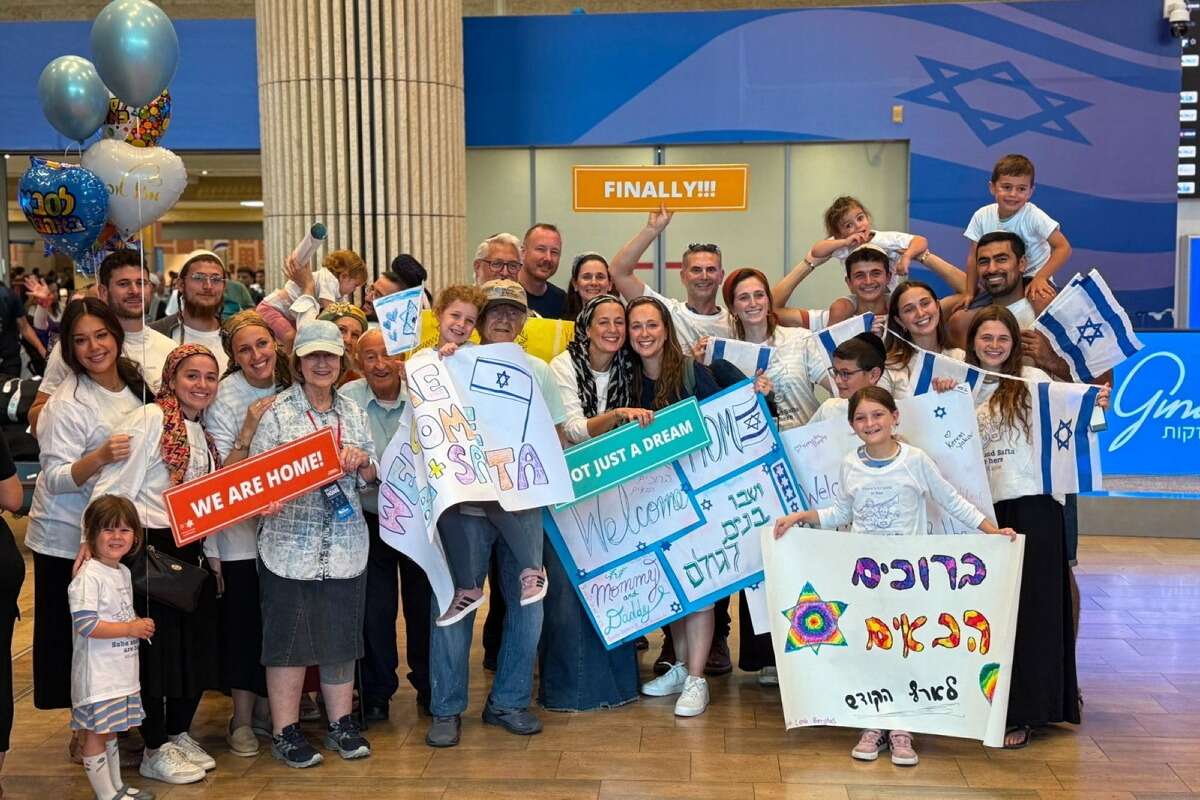
As Yom Ha'Aliyah passed on Sunday, 18th October, it got me thinking about my aliyah journey almost five years ago.
Technically, I'm considered a ktina chozeret (returning minor) as I was born in Israel, but for all intents and purposes, I'm still very much an olah chadasha, despite having lived here for almost five years. Although I speak Hebrew and have Israeli family throughout Israel, my mindset and mentality remain very much British-South African.
Despite having become accustomed to the Israeli lifestyle and culture in many ways, there are still plenty of elements I struggle with, as I'm sure many olim can relate to. For the most part, however, I enjoy living in Israel and try my best to see the humor and good in every day and every challenge, especially when I can turn them into stories.
Those who know me know that I have plenty of stories, particularly fadichot (embarrassing moments) and fashlot (blunders) involving Hebrew mishaps. Anyone trying to learn Hebrew will relate to the daily struggle. Here's a snapshot of some of my best interactions:
Once, when searching for an apartment online, I came across a Facebook post highlighted and starred in bold: "Rak Lavanim." Interpreting this as "only whites allowed," I was furious, told all my friends and almost reported the post. As it turned out, it actually said "Rak Labanim" - "only for boys." Fair enough. Luckily, I hadn't reported it!
Another time, I thought my Israeli roommate had casually informed our WhatsApp group chat that she'd used our toothbrushes (mivreshet shinayim). I was more bewildered than angry, especially when my other Israeli roommate responded, "Bekef" - "with pleasure." After several days of confusion, I reread the message and realized she'd clearly said toothpaste (mishchat shinayim).
More recently, I told my colleague I'd love to meet people in the showers (miklachot) instead of other departments (machlakot).
My favorite, though, has to be when I went into great depth explaining to my doctor that I'm politically centrist and don't take sides when she asked if I was yamin or smol. I couldn't understand why she looked so baffled until she pointed to her hands and I realized she was asking whether I was right- or left-handed.
My non-Israeli friends have plenty of equally embarrassing and amusing stories. There are far too many to write here, but I assure you we repeat them often.
It turns out that Israel's streets and roads are also particularly hazardous. Since making aliyah, I've managed to sprain my foot at least once a year. I've lost track of which foot, but it's become an annual event, to the point where the staff at Terem recognize me and expect me each year.
I also managed to break one of those safta trolleys during my first year here - an experience I'll never forget. I remember watching the two wheels pop off and roll down the road, one at a time, as I schlepped my shopping up the hill in Armon Hanatziv. I was left stranded a few hundred meters from home with an unusable trolley and about 30kg worth of food. It was particularly hot that day, too.
I also can't write about aliyah without talking about public transport. Where do I begin? Those who know me know that nothing makes me more frustrated than getting on a bus (or train) in Israel. I've lost count of the times I've been lurched across the bus as the driver suddenly slams on the brakes. I suspect everyone can relate - Israelis and olim alike.
One memorable incident was when the bus driver slammed on the brakes so hard that I went flying, along with all my shopping. All the passengers were left picking up potatoes and onions that had rolled across the floor and handing them back to me.
Another time, the bus driver got lost and asked me for directions. He then proceeded to use the GPS on my phone to reroute himself, driving backwards up a one-way street to somehow maneuver himself back onto the road.
Of course, there have also been countless bus breakdowns, forcing everyone to clamber off, not to mention the many arguments between passengers and/or with the Rav Kav inspectors, whom I prefer to call the Rav Kav police.
There was also the time the driver stopped the bus, got off and simply disappeared. I can't remember whether he ever came back.
Most recently, I was on a bus packed to capacity, as usual. I was crammed against the wall, there was no air, and two passengers were having an intense argument over goodness knows what. Suddenly, someone spotted an unclaimed bag on the floor and started shouting, "Chefetz chashud!" ("Suspicious item!"). When no one claimed it, he picked it up and peered inside - which you're definitely not supposed to do - before lurching it off the bus at the next stop. This finally seemed to wake up the owner, a man sitting at the back, who shouted, "That's my bag!" I guess he hadn't noticed the commotion or understood English or Hebrew as everyone tried to figure out who it belonged to.
My all-time favorite story, though, has to be the time I was travelling back from a wedding on a coach. The driver pulled into a parking lot to drop off some passengers, then suddenly realized he couldn't turn the bus around. He kept insisting it was impossible.
My friend and I were sitting in the very front row. It was about 1 a.m., we were exhausted, and there was no way we were staying in that parking lot. So we got off the bus and directed the driver with grand hand gestures until he finally managed to turn around and pull out.
The stories above are just a few examples of what an average day as an oleh can look like, and I suspect they're familiar to many Israelis, too.
On the plus side, these incidents have provided me with great content, and I've met some interesting characters along the way, each with fascinating stories. Several people have even invited me for Shabbat meals and/or tried to set me up with their sons or grandsons.
There is so much that can be said about aliyah and the oleh experience. Everyone experiences it differently. I think, for me, it ultimately comes down to your expectations and mindset. Of course, everyone's circumstances are different, and it definitely helps to have a good support network.
I won't sugar-coat or glamorize living here. Aliyah comes with many challenges, frustrations and fashlot. But ultimately, I feel very blessed to be living here, for the incredible opportunities I've had and the people I've met along the way.
And, in the end, these are the stories that make Israel, Israel.