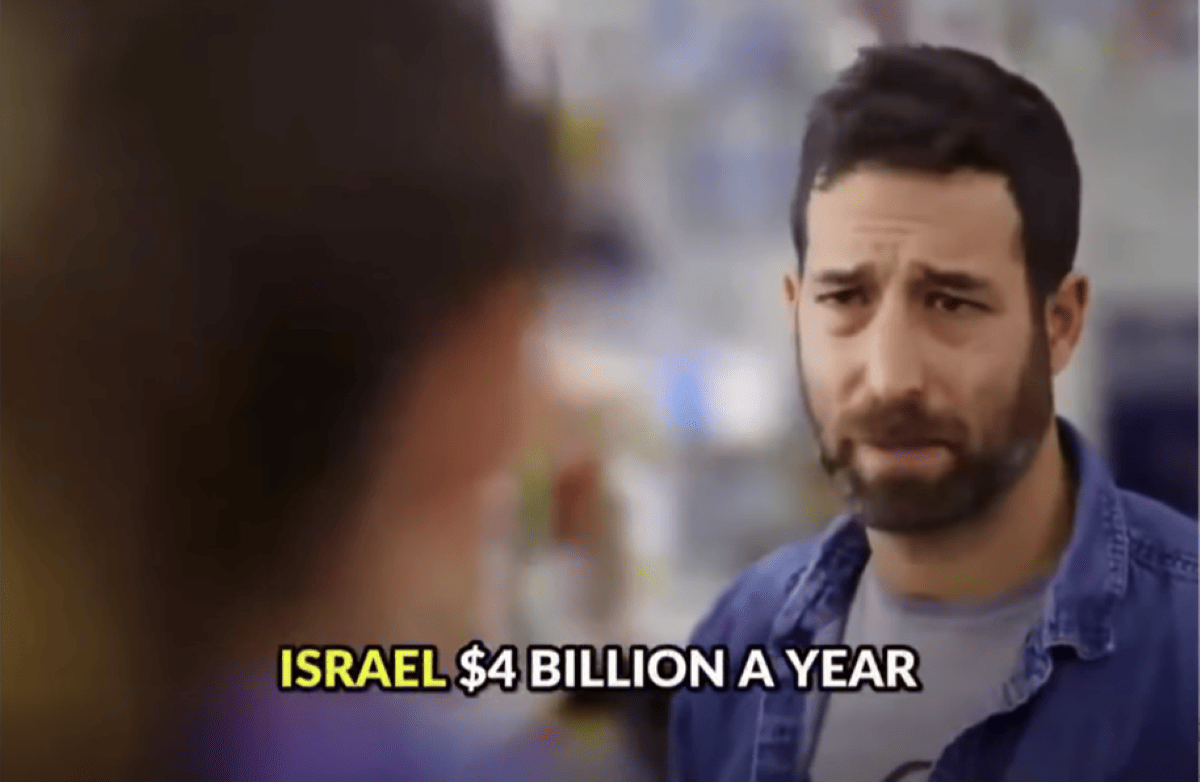
Despite what the Rebellion PAC ad claims, the Jews and Israel are not why Americans can't afford their groceries.
By now, many Americans have seen the wildly antisemitic political advertisement released by the left-wing political action committee founded by The Young Turks co-founder Cenk Uygur.
The advertisement, released in support of Michigan Democratic Senate candidate Abdul El-Sayed, features a couple shopping for groceries who discuss putting back a $7 carton of eggs because they have to "set that $7 aside for killing Palestinians." It goes on to claim that American taxpayers are spending $161 per person to fund military assistance to Israel rather than addressing rising grocery prices at home, and even suggests that Americans are paying for Israel's universal healthcare system.
The ad misrepresents how American tax dollars are spent and exploits Americans' financial frustrations to scapegoat Israel.
The advertisement has drawn forceful condemnation from prominent Democrats, including political commentator Van Jones and members of Congress. Among its most outspoken critics is Michigan Rep. Haley Stevens, who lost the Democratic Senate primary to El-Sayed and has since publicly challenged him over the advertisement. The controversy has exposed deep divisions within the Democratic Party, with Stevens even announcing her support for Republican candidate Mike Rogers.
New @RebellionPac ad dropping in Michigan. We have to suffer here at home, so Israel can get all its wars. That's why they buy politicians like Mike Rogers. He promised to serve Israel "unconditionally," but never made that promise to you. https://t.co/mtgVOyNczg
— Cenk Uygur (@cenkuygur) October 24, 2026
This is one of the most disgraceful political advertisements we have seen in a long time. Although El-Sayed's campaign initially distanced itself from the advertisement, insisting that it had no affiliation with Rebellion PAC, the controversy has also reignited a debate about antisemitism within the Democratic Party is being normalized.
It comes as no surprise that El Seyed will not condemn this vile advertisement, as many of its core messages have been a feature of his entire campaign. Knowing that El Seyed can actually win this Michigan race and become Senator should alarm everyone who cares about the future of the Democratic Party and the future of America.
And in case it wasn't already clear, America's spending on foreign aid is not the reason Americans are struggling to afford their groceries.
Foreign aid accounts for roughly 1% of the entire federal budget, with assistance to Israel representing approximately 0.05% of total federal spending. Much of that assistance is directed toward purchasing American-made defense equipment and supporting joint security programs, reinvesting money into American industries, strengthening domestic manufacturing, and supporting American jobs.
The United States also maintains major security partnerships with countries such as Egypt, Jordan, Japan, Ukraine, South Korea, and Taiwan. Yet Israel is repeatedly singled out in political rhetoric that portrays American foreign assistance as the reason ordinary Americans are struggling financially.
But despite being called "aid," the United States does not provide foreign assistance simply out of generosity. These investments serve important American strategic interests because national security, economic prosperity, and the ability to deter adversaries do not begin and end at America's borders.
The United States cooperates with Israel to confront shared security threats, including the Iranian regime and terrorist organizations that have repeatedly threatened American interests. Intelligence cooperation helps both countries identify and respond to emerging threats, while joint military research and technological development strengthen their respective defense capabilities.
This relationship also provides the United States with intelligence, technology, and regional capabilities that would be costly and difficult to replicate independently. Far from being a one-sided arrangement, America's partnership with Israel serves important strategic interests in one of the world's most volatile regions.
And this is precisely what isolationists on both sides of the political spectrum, whether on the left like Abdul El-Sayed or on the right like Tucker Carlson, consistently fail to acknowledge.
If America does not cooperate with its allies, its adversaries will most certainly continue cooperating with each other.
Today, China, Russia, Iran, and North Korea are expanding their military, economic, and technological cooperation. America's adversaries understand the strategic value of working together, and the United States cannot afford to ignore the importance of its own alliances.
Despite its powerful military and economy, America cannot confront every global threat alone. Maintaining strong alliances is not an act of charity. It is an investment in American security, economic stability, and global influence.
Of course, Americans have every right to debate how their tax dollars are spent, including the amount of foreign assistance provided to Israel or any other country. But there is an enormous difference between a legitimate debate over foreign policy and an advertisement that exploits Americans' economic frustrations by suggesting that the Jewish state is responsible for their inability to afford basic necessities.
Blaming Israel for the rising cost of groceries or the financial pressures facing American families is not a serious economic platform to address the country's cost-of-living challenges. It is a manipulative attempt to redirect legitimate economic frustration toward the world's only Jewish state, offering Americans a convenient scapegoat instead of meaningful solutions.
We have seen this story play out before, and we already know where this kind of scapegoating can lead. So as Americans head to the midterm elections, remember one thing: The Jews are not the reason Americans cannot afford their groceries.