1
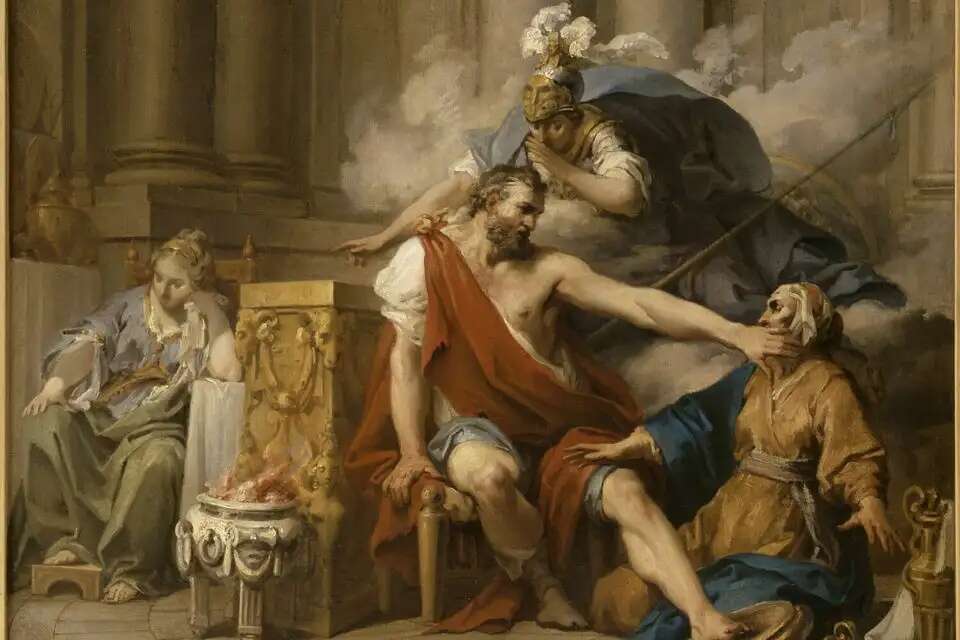
For 20 years, he had been away from home. He wandered through foreign lands, facing threats and mortal dangers. By day, the scorching heat consumed him, and by night, the frost robbed him of sleep. In his absence, others coveted his home and sought to rule his land. When he finally managed to return, he was forced to fight strangers who opposed his homecoming and sought to kill him. Casting off his disguise, he revealed himself as a fearless warrior, battling his enemies until dawn, when he finally overcame them.
Who was this man? Was it Jacob, returning from 20 years of exile in Laban's household and fighting his brother Esau? Or was it Odysseus, who likewise returned after 20 years, disguised as a beggar, and fought the suitors who had taken over his palace and squandered his wealth while pressuring his wife to marry one of them, thereby allowing him to assume control of the kingdom?
2
Western civilization was founded on two pillars: On the one hand, Homer's great epics, the Iliad and the Odyssey; on the other, the Bible. From these emerged philosophy and morality, faith and our understanding of reality, and science. As Europe disavows its roots and forgets Athens, Jerusalem remains its last hope. Through the Torah, the Jewish people remind Europe where it came from and what it must do to survive.
The Iliad recounts the war between Greece and Troy. At the heart of the conflict was the violation of the sacred institution of xenia, the custom and unwritten law of reciprocal hospitality (derived from the word xenos, meaning "stranger," "guest" and "host").
In a world where roads were dangerous, travel was slow and lodging establishments were virtually nonexistent, xenia was essential to the survival of civilization. It fostered trust and enabled diplomatic relations. Moreover, it sustained trade and economic activity. Had merchants been unable to travel safely with their goods, the city-states would have remained isolated and technologically and socially underdeveloped.
3
When Paris, the prince of Troy, abused the hospitality of King Menelaus of Sparta, abducted his wife Helen and plundered the treasures of his palace, he committed the gravest possible violation of xenia, trampling the social, political, religious and moral order of the ancient world. Greece's war against Troy was therefore neither a war to defend the honor of a betrayed husband nor a campaign of conquest, but an act of retribution intended to restore the cosmic and social order.
Compare the destruction of Troy with that of Sodom, which likewise violated the institution of hospitality. Upon learning that Lot was hosting the angels in his home, the townspeople surrounded the house and demanded that he hand over his guests. The Bible emphasizes that Sodom's sin lay in the fact that its cruelty was not merely the conduct of a handful of criminals, but was enshrined in the laws of the city. By protecting Paris and refusing to return Helen, Troy crossed the line between an individual criminal act and the law of the land.
The Odyssey is the sequel to the Iliad, recounting Odysseus' return to his home in Ithaca 20 years after setting out for the Trojan War. In his absence, strangers exploited the hospitality of his wife and son, brazenly took over his palace and demanded that Penelope marry one of them. In doing so, they sought to become rulers of the kingdom. They, too, violated xenia. Worse still, they sought to murder his son Telemachus and, of course, Odysseus himself upon his return.
4
After a long and turbulent exile in the household of Laban the Aramean, Jacob returns to his homeland. When he is left alone, Esau attacks him to settle an old score. But Jacob has changed. He is no longer the "quiet man, dwelling in tents." Rather than flee, he now fights for his ancestral inheritance.
When his adversary realizes that he cannot prevail, he asks to leave, perhaps intending to regroup and return to fight another day. But Jacob refuses to relent: "I will not let thee go, except thou bless me." (Genesis 32:26), If you wish to emerge from this struggle alive, you must bless me. In other words, you must acknowledge that the blessing is rightfully mine and that this land belongs to me as part of my ancestral inheritance.
Thus, for the first time in history, our name was born: "And he said unto him: 'What is thy name?' And he said: 'Jacob.' And he said: 'Thy name shall be called no more Jacob, but Israel; for thou hast striven with God and with men, and hast prevailed.'" (Genesis 32:27–28).
When the Jew returns home and refuses to retreat in fear of his enemies, he becomes Israel, a people that grapples with God (that is, with its identity) and with men (that is, with the nations of the world), and prevails. It reconstitutes its national identity and defeats the enemies who oppose the return to Zion, both in its immediate surroundings and on the international stage.
5
Jacob returned after 20 years; his descendants, the Jewish people, returned after 2,000. From a historical perspective, this is the difference between the lifespan of an individual and that of an ancient nation.
When we returned, we found strangers who had invaded the land, much like the Philistines who invaded Canaan from the late 13th century BCE onward, following the collapse of Mycenaean civilization (perhaps as a result of the wars between Greece and Troy?).
The neo-Philistines of our time call themselves "the rightful owners" (you have heard them in the Knesset). They never truly courted this land, but merely lived in it as part of a broader Arab region, without national aspirations. The land, for its part, did not reciprocate their affections. Throughout their years here, it remained desolate, awaiting the return of its beloved. When the Jewish people began to return, and its rightful owners finally arrived, the land responded, blossoming, prospering and bringing forth abundant offspring.
For "the Land of Israel is not something external, an external possession of the nation," Rabbi Abraham Isaac Kook wrote at the beginning of Orot Eretz Yisrael ("Lights of the Land of Israel").
This land is not merely the physical setting of our existence, nor even simply a spiritual framework in which to observe the commandments specific to the Land of Israel. "The Land of Israel is an intrinsic entity, bound to the nation by a bond of life, intimately intertwined with its existence through inner qualities."
It is the other, profound dimension of our identity. That is why, when we are absent, the land dies. And when we come back to life and return to it, the land, too, awakens to greet us and shapes our development as a nation.
At the culmination of a historical process, when the invaders realized that we had returned home not as individuals but as a nation seeking to restore our days of old, they waged war against us, a war that has yet to end. Just as Jacob fought Esau for his life and his inheritance of the land, continuing the struggle of his father Isaac against Ishmael, so too are we fighting for our rightful inheritance in our only homeland.
6
Europe has forgotten the founding narrative of its civilization: the war against Troy, which sheltered the man who violated the institution of hospitality, and Odysseus' life-and-death struggle against guests who had taken over his kingdom and threatened his life and those of his family.
Having forgotten this lesson, Europe has allowed tens of millions of foreigners to exploit its hospitality and gradually but steadily take it over, while openly declaring their desire to Islamize Western civilization, after failing twice before, in 732 at the gates of France and in 1683 at the gates of Vienna.
Odysseus still bore the scar on his leg, his distinguishing mark by which his elderly nurse recognized him. Europe, however, is increasingly unable to recognize itself. We are here to remind it that it is not too late.
Jacob emerged from his struggle "limping upon his thigh," a symbol of the grievous wounds inflicted upon us by our enemies over millennia of Jewish existence. The struggle, which lasted throughout the long night of exile until dawn, concludes with the words "and the sun rose upon him," the sun of redemption and national rebirth.
Homer's Odyssey laid the foundations of the West, but its continued existence is intertwined with the odyssey of the Jewish people and its moral culmination: the establishment of the State of Israel.