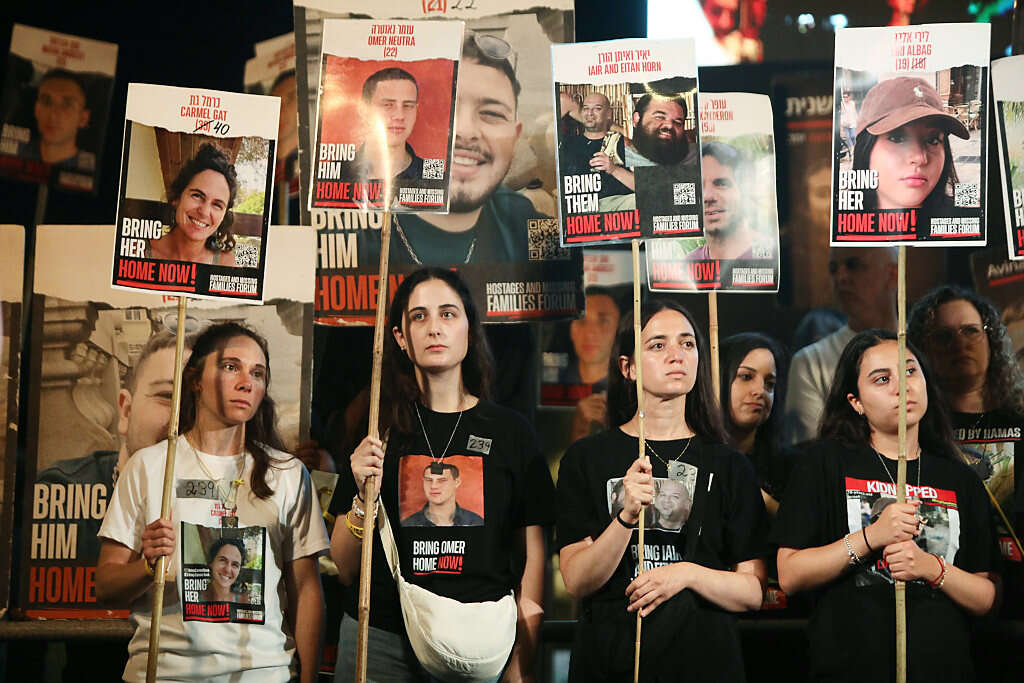
The news that Hamas was planning to dig up corpses from an old British cemetery in the Gaza Strip to pressure the British government to turn against Israel shines a spotlight on a question that needs to be asked: How did dead people come to be regarded as "hostages"?
In normal discourse and popular culture, a hostage is typically a person taken prisoner and held bound in some basement – alive – while the kidnappers wait to see if their demands will be met.
A person who is kidnapped and murdered is not normally referred to as a "hostage." He or she is referred to as dead – as a murder victim.
Yet in recent months, mainstream media agencies have been reporting that Hamas is holding 110 Israeli hostages, one-third of whom "are believed to be dead." Technically, a dead body can be held hostage, but normally, live prisoners are called hostages, and dead ones are called corpses.
If Hamas had proceeded with its plan to dig up dead British soldiers from long ago, would the British media describe those corpses as "hostages"? I doubt it.
Would the British public demand that their government change its entire Middle East policy in order to get the bodies back? I doubt it.
Would anybody call for the release of convicted Muslim terrorists serving jail sentences in Britain in exchange for the corpses? I doubt it.
Yet that's exactly how governments around the world and media agencies are treating the question of the dead Israelis in Gaza.
Why? Because it's a way of increasing pressure on Israel to cease firing at Hamas.
Throughout the 10-month-long war in Gaza, those who want to stop Israel from defeating Hamas have been pushing the idea that Israel should release thousands of terrorists and stop pursuing Hamas in exchange for Israeli hostages.
But as the months have passed, the number of hostages has decreased. Some were released in an exchange last November. Some were rescued. And, according to Israeli officials and other sources, many others were murdered either on Oct. 7 or subsequently, and some of those bodies have been recovered.
The smaller the number of hostages, the less incentive there is for Israel to cease firing and free thousands of terrorists. The smaller the number of hostages, the greater the possibility that Israel might be able to rescue them. And the smaller the number of hostages, the fewer terrorists Hamas can demand in exchange for them.
So for all those in the media and the international community who want to see Hamas saved from destruction, the larger the number of hostages, the better.
It's not that editors or diplomats want to see Israelis – or anybody else – held hostage. It's that they either sympathize with the Palestinian Arab cause, or they are terrified that Hamas might murder them next.
It's not a conspiracy; it's that those who favor one side naturally have constructed a narrative that advances their cause. And so a narrative has gradually taken hold in the news media and the diplomatic world in which events are described in ways that are advantageous to stopping Israel and saving Hamas.
They want to see Hamas appeased, not destroyed. They want to prevent Israel from achieving victory because an Israeli victory would infuriate the Palestinian Arabs and the Arab world in general. The plight of the hostages, therefore, has become a political weapon. And inflating the number of hostages – by adding dead bodies to the total – has become part of that pressure campaign.
Of course, Israel would like to secure the return of the bodies of the murder victims. The victims' families deserve closure, and the dead deserve a proper burial. Still, not many Israelis would support releasing thousands of terrorists or letting Hamas remain in power to do so.
The only way to push the plan through without significant Israeli public opposition is to exploit the hostages by promoting the idea that the corpses, too, are "hostages." And if there's one thing Israel's enemies are very good at, it's exploitation.
Reprinted with permission from JNS.org.